What follows is a rough outline sketch of the message I presented Sunday evening, February 19. I am indebted to the good (but not great) commentary, 1, 2 Samuel (NIV Application Commentary) by Bill Arnold. I know some guys who love this series, and some even say they take it straight to the pulpit. I just don't think it is that good -- frankly I don't think any commentary should be a substitute for a pastor preparing his own messages for his own flock each Lord's day. However, I consult commentaries because I don't know it all, and neither do the guys writing the commentaries, but together we are in a conversation about the text, sharpening the point toward truth in exegesis (what the text says) and hermeneutics (what the text means), and then in homiletics (what we preach about the text). In this case, the commentary helped me develop the outline of the passage.
1 Samuel 13: The Anatomy of Sin
I don't know many Christians who would wake up in the morning and say, "I really hope I sin today." But I don't know many who lie down at night and say, "Thankfully, I didn't sin today." We don't want to sin (I trust), but we often do. How does this happen? Let's learn from Saul's errors here and try to recongize these patterns in our own lives as well.
I. Fixation on the moment at hand (vv5-8)
* Failure to remember lessons and testimonies from the past.
* Failure to consider consequences for the future (see vv 13-14)
II. Execution of Partial Obedience (vv 8-9)
* The timing of the matter is only part of the equation.
* Acceptance of the boundaries of one's position, responsibilities, and authority is another.
* Saul may be kind, but he is not the Supreme Authority. God is. And Saul is answerable to God and His prophet/priest. Saul's attitude demonstrates a pride that refuses to accept his limited authority and the authority of another over him.
III. Rejection of responsibility (vv 10-12)
* The blame game (just like Adam and Eve)
* Making sin small. Anytime we do this, we are in great danger. To minimize sin is to minimize the cross, which is blasphemous at best, completely and absolutely anti-Christ at worst. We should recognize and accept the magnitude of our sins so that we can fully experience the magnitude of God's grace. John Wesley said, "There is no little sin because there is no little God to sin against. In general, what to us seems a small offense, to him who knows the heart may appear a heinous crime."
There are many parallels between this story and the story of the Fall in Genesis 3. We see the same patterns there and in our own sins as well. Saul was right where God wanted him to be -- he was anointed, Spirit-filled, empowered by God for the task at hand. But all it takes is a moment of ceasing to trust and obey for a downfall to occur -- in Saul's life, in my life, in your life.
Tuesday, March 07, 2006


Psalm 67: Let the Nations Be Glad
What follows is my Sunday Morning message from 3/5/06. We commissioned some of our church members for a long term missionary assignment. They are traveling to a secure area, so I have replaced their names with *** and the name of the country to which they are traveling with @@@.
Psalm 67
Let the Nations Be Glad!
Today is a great day in the life of
& Psalms 67:1 (NASB) 1 God be gracious to us and bless us, And cause His face to shine upon us— Selah .
This is the way we like to pray. We like to stretch our hands out toward heaven and ask God to do something for us. And there is nothing wrong with that. The psalmist does it here. We can insert our name, or the name of our loved ones, right into the text where it says “us.” I can pray, “Lord, be gracious to me and bless me, and let your face shine on me.” I can pray, “Lord, be gracious to Donia and bless her, and shine your face on her.” We can insert “
God, be gracious to Immanuel, and bless Immanuel, and cause His face to shine upon Immanuel.”
Now, the Psalmist says Selah. This is a word that is employed periodically in the psalms as if to say, “Pause and reflect for a moment.” If we think about it for a moment, we might wonder, “Why should God answer this prayer? Why should He show us more grace, and bless us even more than He already has? We already have an infinitely unpayable debt of gratitude toward Him. Isn’t it selfish of us to ask for more? Why should He answer this prayer? The Psalmist tells us in the next verse.
& Psalms 67:2 (NASB) 2 That Your way may be known on the earth, Your salvation among all nations.
The most important word here is that. God shows us grace and blesses us, and shines on us so that through us, He might bless the world. That is what He promised Abraham in Genesis 12.
& Gen 12:2-3 (NASB): 2 And I will make you a great nation, And I will bless you, And make your name great; And so you shall be a blessing; 3 And I will bless those who bless you, And the one who curses you I will curse. And in you all the families of the earth will be blessed."
God had promised to do all this for Abraham so that through Abraham, all the families, that is not the Jews only but all nations would be blessed. This is how God has worked throughout human history, and it is the basis of the Great Commission. If you have been blessed by God, it is not so that you can sit around pondering how good it feels to be blessed. He blessed you so that blessing might flow through you to someone else. And throughout the Scriptures, what becomes apparent is that God has a heart to bless all nations.
So many of us grow up in church and Sunday School, and yet still miss this point. God did not pick
When the Bible speaks of nations as it does here in Psalm 67, the reference is not to geopolitical states, lines on a map like we think of when we say the word. We use the word nation to refer to the
A significantly large grouping of individuals who perceive themselves to have a common affinity for one another because of their shared language, religion, ethnicity, residence, occupation, class or caste, situation, etc. or combinations of these. … It is the largest group within which the Gospel can spread as a church planting movement without encountering barriers of understanding or acceptance.
Now, the numbers vary, but the figures our mission board uses tell us that there are approximately 12,000 of these people groups in the world today. Let me illustrate with an example we can all relate to: We think of
"Worthy are You to take the book and to break its seals; for You were slain, and purchased for God with Your blood men from every tribe and tongue and people and nation. You have made them to be a kingdom and priests to our God; and they will reign upon the earth."
So, if you have a problem on earth accepting people of another culture, then you will be miserable in heaven, because we will all be one there. And the
God loves all people from every nation. God made them all in His image, the Bible says, “from one blood.” Christ died to redeem them all. And God desires that every nation learn of Him. He longs for them to be saved. He desires praise from all people of the earth, His praise being lifted in every language under heaven. And when we understand this, it changes the way we pray. No longer is the focus on us, and the blessings we want. The focus is on God. “God, be gracious to us, and bless us, and let your face shine on us, so that Your way may be known on the earth, Your salvation among all nations.”
Look at the next verses (vv3-4) of Psalm 67:
& 3 Let the peoples praise You, O God; Let all the peoples praise You. 4 Let the nations be glad and sing for joy!”
The focus is now on God receiving the worship He deserves from all the peoples of the earth. Worship is the fuel and goal of missions. Missions begins as God’s people worship Him and draw close to Him, understanding His heart for all nations. And that kind of worship fuels missions. But worship is also the goal of missions. Missions exists because worship does not. Obedience to the Great Commission will only motivate us in a laborious sense. Love for the lost will motivate us only temporarily. But when our consuming passion becomes the desire to see God’s glory displayed and magnified in all the earth, nothing will stop us advancing His cause to the ends of the earth.
How would our lives be different, how would our church be different, if our consuming passion was to add worshipers to the
So there is a top line – God blesses us. And there is a bottom line – see verse 7:
God blesses us, that all the ends of the earth may fear Him. This is not necessarily the terror or dread of the Lord, but rather the whole faith and trust of people placed in God. Now surely, there is much to dread if we refuse to surrender to Him. But there is a fear of God that is a joyous relief, when we transfer all of our trust over to Him and allow our lives to be consumed by His glory. That is our goal. That is why we want God to bless us – so that through us, someone else might come to know Him.
God has blessed us. And because He has blessed us so richly and so abundantly, we have an obligation on this bottom line. We owe our testimony to the rest of the world. We must be willing to use our lives to bring glory to God by bringing the peoples of the world to Jesus. There are multitudes in
But it is legitimate to ask that question. What about the multitudes of lost in
Let me illustrate the bleak picture of the state of the gospel in the 10/40 Window with an example from China.
*** are going to serve as missionaries in @@@. I assure you it is a difficult place to labor for the gospel. Everything we have described about China could be said just as well about @@@. You say, “But it is not safe.” My friends, the events of September 11, 2001 should have taught us that there are no safe places. But the safest place to be is where God calls you. And this is where God has called them. He has not promised them safety. He has not promised them success. But He has promised them that if they will go, He will use them for His glory in
This dear couple has volunteered to go! Some of you have responded to God’s call to give, and others of you will want to give more toward their expenses of this mission opportunity. Many of you will be the mighty prayer warriors who will fight for them on your knees. But today every one of us has a biblical obligation to surround them with support as we commission them and commit them into the Lord’s hands. Through our prayers, our giving, and our encouragement, we are partners with ***. And while they are gone, we must pray for them in every gathering, and daily in our private prayer time. Right now I want to ask them to come and share with us briefly what they can about their opportunity and anything else God has laid on their hearts, and then we shall gather around them to pray for them.
Monday, March 06, 2006
Instructions for Commenting on Blogs (for the especially dense)

Hello readers in the blogosphere. I received the following request from a certain U.S. Marine who was trying to post some inane comments on my blog: "I tried to get on your blog again. It won't let me get to the place where I can write. I click on the "comments" button at the bottom. Is that right? What is the right way for me to get to the page where I can view entries, and add my own? Walk me through it step by step since I obviously can't figure it out on my own."
In response to his request, I sent the following directive. You must bear in mind that the Marine in question is a dear friend, and we exchange sarcastic jabs on a daily basis in email. Here is the "step by step" directive I sent him:
Accessing and Commenting on Internet Weblogs, often referred to as "Blogs"
1. At the back side or your computer (the side with vents and fans and various recepticles), locate an object that looks similar to a tail. This is the electric plug. Insert it carefully into an active 110 power outlet. If it is hard to insert, do not force, but turn the plug upside down and try again.
2. Locate the button or switch which turns the computer on ("turn on" here is used in its literal sense, not in some euphamistic way). Engage that button or switch.
3. Follow all prompts and sign-on screens until you are able to see what is called "the desktop." This is a figurative term. It does not refer to the top of your desk, but the "lauchpad" for your programs. Usually there will be a picture in the background and little pictures (called icons) which represent the various programs you may use.
4. Ensure that your computer is hooked up to the internet. If you are uncertain how to determine this, you may want to contact IT. (That is short for Information Technology, not a reference to Cousin IT from Addams Family).
5. Once you are certain that you are connected to the Internet, open your internet "Browser." (There was once a singer in Sha-Na-Na called Bowzer, but this is a Browser, notice the lowercase "r" in the word's second position). Some popular browsers are Microsoft Internet Explorer, Netscape Navigator, Mozilla Firefox, et al. (that is a Latin abbreviation for "and others").
6. Once your browser is open, locate the "address bar." This is not a "bar" like where people drink alcoholic beverages, but it is a line across the page (usually at the top) where you can type in the address of the internet page you are tyring to access. Once you locate that bar, place your "cursor" (not a person who uses foul language [though these are often found in bars as well], but a blinking vertical line that indicates where you will type) in that bar. You do this by moving your mouse to the address bar, and clicking the left mouse button (if you are right handed, this is the button beneath your index finger on the mouse. If you are left handed it will be beneath your "middle finger"-- the one you use when expressing your frustration with others). WARNING: It is assumed that the user is aware that the "mouse" is not a real animal, living or dead, but is a figurative name given to the small, palm-sized device that is used for moving the "arrow" around on the screen. If using a laptop, blackberry, PDA or Web-enabled mobile phone (or other electronic device), you may have to read the instructions for that device to learn how to move the cursor around.
7. Once you have placed the cursor in the address bar, begin to type the internet address. Your browser may already contain the beginning characters: http://
If those characters are not present, type them in this order: http://
Then type the address of the site you are looking for: www.marines.com; www.nickjr.com; or www.aljazeera.net
If you desire to view and comment on internet weblogs, commonly called "blogs", access a blog like the one found at http://russreaves.blogspot.com.
After entering the "address" of the internet site, press enter or click "go".
8. Once the site "loads" (STAND DOWN AND DO NOT BE ALARMED: it is not loading a weapon, it is loading information onto the screen of your computer), "browse" the information on that page.
If you desire to comment on a blog after reading it, scroll (either by moving your mouse or using your arrow down key on the keyboard) down to the end of the article on which you wish to comment. Click the word "comments" with the left button on the mouse.
The next page that you see will have a large white square on the right hand side of the screen labeled, "leave your comment." Type your comment in that square, identify yourself (it is a violation of national security and the renewed patriot act to select "Anonymous"), and type in the characters in the "security image." This is to ensure that no al-Qaeda operatives are invading American cyberspace. WARNING: these characters are intentionally obscured. Your eyes might be funny or you may be drunk, but even if that were not true, these letters and numbers would still look funny. However, you should type the letters on your keyboard that most closely resemble the obscured characters on the screen. If necessary, decoder rings may be found in select boxes of Cracker Jacks. Odds of winning are 1 in 5,000. No purchase necessary.
After entering all the above information click the bright blue box labeled, "Publish Your Comment."
Then you are finished wth commenting on the blog.
If any of these instructions do not work, please contact IT. Again this is not Cousin IT, but the Information Technology department.
Wednesday, March 01, 2006
Bookblog: The Gospel Blimp and Other Modern Parables
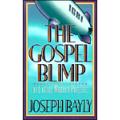
Looking for a lightweight read to rest my mind over recent days, I picked up The Gospel Blimp and Other Modern Parables by Joseph Bayly. Being one not given to idle thinking, I also thought that this might help me to creatively think God's thoughts after Him as I endeavor to teach seven students at Winston-Salem Bible College in the subject of evangelism. Now, having completed the book I confess to having laughed and cried (sometimes without even turning a page), and having misjudged this book by its whimsical cover -- it is no lightweight read. I had heard about The Gospel Blimp at times before, but I was unfamiliar with its author, the late Joseph Bayly. I was not one of the "thousands of people" who "for over twenty years ... looked forward to his monthly column in Eternity magazine" (back cover). Although I have used some of the fine material published by the David C. Cook company, I did not know that Joseph Bayly had been president of that company before he died.
A little less than half of the book is devoted to its title story, "The Gospel Blimp." This story is humorous, painful, convicting and compelling as it chronicles the adventures of a group of well-intentioned but misguided believers who desire to reach their neighbors for Christ. Rather than being personal witnesses to them, they devise the plan for The Gospel Blimp, a flying billboard which spells out the gospel, announced the saving message through loudspeakers, and blankets the city with tracts dropped from the blimp's lofty heights. And thus begins the misadventures of the IGBI -- International Gospel Blimps, Inc. Without giving too much of the story away, let me just say that their capers strike closely to the nerve of evangelicalism's big business parachurch ministries. And it is not without the scandals that often accompany these ventures. In the end, there is fragmentation at the leadership level, which ends up being the best thing that can happen in the reaching of the lost in that city. This story is an encouragement to us to not look for bigger and better ways to do it, but to just be faithful to the simple personal sharing of the life-changing gospel of Jesus Christ with our friends, our neighbors, and the strangers brought into our lives by the providence of God.
Not all of the "modern parables" are of equal quality, though I would have missed a blessing by putting the book down after the saga of the blimp. The story of Gooley is one of the most creative and refreshing stories I have read in a long time. Gooley is a young man who learned to fly. Not in an airplane, not with some apparatus -- the guy actually learned to just fly. It soon becomes apparent that this is Bayly's parallel to being saved. But rather than teaching fellow students at his secular university the secrets of his flight, Gooley transferred to an "All Flyers School," where the student body had become bored with flying and some had even begun to doubt the authority of Aerodynamic Theory -- the primary text for flying and flyers. It is a great story for Christians to read to keep the fire of their zeal for Christ burning hot.
Picking up on similar themes of "The Gospel Blimp" are the shorter stories of "A Small Happening At Andover" and "Black Gold". "Mayday" is humorous, and "Rehoboam's Gold Shields" is a heartbreaker for Christians who know people who have drifted away and shipwrecked their faith. "How Silently, How Silently" is a convicting look at how we have croweded Christ out of Christmas. I reflected on this story as I drove to Myrtle Beach this past weekend. Somewhere north of Bennetsville, SC on Highway 38, there is a little family cemetery on the right hand side of the road across from what appears to be an abandoned church. Even at 50 miles per hour or so, I was able to make out the name -- one name on every tombstone in that little burial ground: CHRISTMAS. When I saw that, I reflected on "How Silently, How Silently," and said, "Oh Lord, forgive us. We have killed Christmas, and buried it here in a shallow grave in South Carolina. Please resurrect it in the hearts of your people so that we will treasure Christ more than any of these trappings that we often substitute for Him at what should be a very special time of year for Your people." I will try to post the photo of that cemetery I took on the return trip at a later time.
The most painful story of the collection for me was "The Saving Message." Every preacher needs to read this story. Pressed in the strait between knowing the message that he must preach, and knowing the fallout that will result when he does, the preacher of this story wrestles with the recent news in his town and what his responsibility is before God to address it. The conclusion is shocking, alarming, and convicting, because ALL OF US, even the best of us, have been guilty of the same sin as this preacher in the story at some point.
The final chapter of the book is a very good look at the art of the parable. Bayly does not romanticize parables as some are wont to do. Though I do not think that we need to abandon exposition in exchange for story-telling in our day (that apathetic spiritual anorexia that plagues our churches is the consequence of a century of this), I do think that we could enhance our exposition with some very pointed parables told in the style of Jesus and prophets like Nathan.
On the whole, I would recommend The Gospel Blimp to believers who can tolerate a little bit of self-depricating humor and imaginative storytelling. But beware, these are not lightweight tales. They cut like a knife if we read them with ears to hear the message that underlies the engaging characters and their exploits.
Bookblog: Don't Waste Your Life
 Having heard John Piper speak at the NC Evangelism Conference (by the way -- great conference and the messages are available for free download at www.calvarynow.com/evangelism), and knowing that he was preparing for major prostate surgery, I felt compelled to read yet another of the works of this great man of God. When I met Dr. Piper at the Conference, I found him to be a gracious and humble man. I told him that I had quoted him so often in conversation that my wife just assumed that he died 200 years ago (I don't quote many who are still around -- dead preachers don't change their minds). He chuckled with me about that, and assured me, just days before his surgery that he was "alive and well." He did endure that surgery very well from reports I read online, and for that we praise God. Now on to the book -- Don't Waste Your Life.
What drew me to the book was the humbling story that graces the back of the book. "I will tell you what a tragedy is," Piper writes. "I will show you how to waste your life. Consider this story from the February 1998 Reader's Digest: A couple 'took early retirement from their jobs in the Northeast five years ago when he was 50 and she was 51. Now they live in Punta Gorda, Florida, where they cruise on their 30-foot trawler, play softball, and collect shells. ...' Picture them before Christ at the great day of judgment: 'Look Lord. See my shells.' That is a tragedy."
As I read those words, I thought, "Oh my! That is the American Dream isn't it?" That is what most of the folks in the congregations I have served would think is success in life. And I confess that on far too many days, that is what I long for more than the daily grind of being stretched and stressed in the work of ministry. But like a mirror -- not one of those funhouse mirrors that you know is making fun of how you look -- but a true mirror that reveals the awful blemish that scars us, Piper's words pierced me. Inside the pages of the book, the wound grew deeper, but it was a cut toward healing.
Piper's autobiographical glimpses in the early chapters are a blessing to one like me who has enjoyed his writings for many years. Many of the phrases that recur in all of his writings ("God is most glorified in us when we are most satisfied in Him," "Missions exists because worship does not", et al.) are found in this book as well, but his autobiographical sketch allows us to follow him on the life journey that led to the discovery of these wonderful truths. A theme that I am seeing more and more of in Piper's writings is that being loved by God does not mean that God makes much of us, but rather that God has done all that is necessary to enable us to make much of Him forever.
Three main points I want to highlight here are Piper's comments on suffering, on vocation, and on global missions. Several years ago, I read a chapter written by Piper in a book on expository preaching called Feed My Sheep. That chapter was on preaching to the suffering, and in it, my entire outlook on the pain and suffering of God's people was challenged and changed. Those same convictions were found in this book as well, as Piper reveals (in this culture of concealment) the true cost of discipleship. Following Christ might just be lethal -- but what other alternative do we have? He suffered for us. Not that we won't have to suffer, but that our suffering might be for His glory and the spread of His name among the nations.
Concerning vocation, Piper reiterates the doctrine of priesthood of believers advanced during the Reformation by Martin Luther. "Career Ministry" in the form of pastoral work or missionary service is by no means more important than the calling to live for Christ in secular vocation. Piper gives a biblical theology of secular work for the glory of Christ in Don't Waste Your Life that is unparalleled in modern literature. However, he acknowledges that in that role, one may find a connection with the life of suffering and the life of missionary advance.
If you have ever read Let the Nations Be Glad! (and shame on you if you haven't!), you know that Piper has a "white-hot passion" for global missions to the unreached peoples of the earth. In Don't Waste Your Life, Piper unashamedly calls every follower of Christ to examine his or her life to evaluate the contribution being made to the advancement of the gospel on the frontlines. He even pleads that many who read this book will give their lives to career missions, a challenge that he confesses issuing to himself each year at Bethlehem Baptist Church's Missions Conference.
Jonathan Edwards, C. S. Lewis, Dietrich Bonhoeffer, Martin Luther, Adoniram Judson, Samuel Mills, and a host of other (perhaps more surprising -- like the Marines of Iwo Jima) influences make cameo appearances to reinforce Piper's points along the way. Their words resonate with his own calling the reader to abandon all pursuits that will lead to wasted life, and in exchange begin to seek nothing but the glory of God being displayed through one's life.
I don't think I have read a book in recent days that I have enjoyed more than this book, and I would encourage all in my limited readership to acquire a copy and devour it at your earliest opportunity. It is plain to me that Piper has written this book to a younger audience (college students and early career adults), but I found myself on multiple occasions pricked in my own conscience by his stirring words, and thinking how relevant his message would be for the most advanced senior adults as well. I have recently picked up his latest book God is the Gospel, which looks like it will expand some of the themes introduced in Don't Waste Your Life.
As I bring this bookblog to a close, let me say a word concerning a popular prejudice against Dr. Piper. I overheard this conversation at the NC Evangelism Conference before Dr. Piper was to speak. Someone asked a colleague, "Who is John Piper?" (Can you imagine!). The colleague smirked and retorted, "Just some Calvinist!" The following week, the Biblical Recorder (or Biblical Distorter as it is called in some circles) reported on the conference with banner size headlines reading something to the effect of "Piper Adds Calvinist Flavor to Conference." Indeed, John Piper is a Calvinist. He would be the first to tell you that. But I believe that he would also be quick to point out that he is not a hyper-Calvinist who believes that only the elect should be preached to. In fact, I heard him say that we do not know who the elect are, so we must preach to everyone. And I would also like to say that Piper is a Calvinist, but he is more than a Calvinist. In Evangelicalism today, we feel like once we've labeled something, we have it figured out. People don't read Piper or go to hear him speak because they have him figured out already -- "He's just some Calvinist." Beloved, I am not a Calvinist, though I often get mistaken for one because my views run so parallel to Calvinism (If you must know I am a Molinist, meaning I hold to Middle Knowledge. I used to be a "reluctant Calvinist" because I thought my only other alternative was to be an Arminian, and who wants to be "a dopey Arminian" as my undergrad philosophy professor said.). Yet, even though I am no Calvinist, I don't think there is a writer alive today who blesses and feeds my soul like John Piper. So, can I call us evangelicals to a laying down of the labels and an opening of our minds to hear one another share our passions for Christ and rejoice together where we agree and dialogue together where we disagree? Please, for the glory of Jesus, let us do this all the more as the day approaches.
Subscribe to:
Posts (Atom)
