Thursday, October 20, 2011

Good Advice from Spurgeon


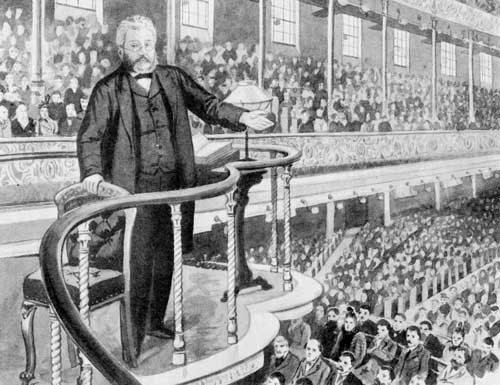
"Brother, if you preach God's Word as He gives it to you, you have nothing to do with the consequences that come of it. God will justify His own truth; and even if it should seem that the worst rather than the best consequences ensue, it is for you still to go on in the name of Him who sent you. Whenever you and I begin to try to manage God's kingdom for Him, we find the divine scepter too heavy for our little hands to hold."

- From Spurgeon's Exposition on Jonah 4. 

Thursday, September 08, 2011

What We [Should] Have Learned Since 9/11

Earlier this week, I sat down with a legal pad and wrote across the top of it, "What have we learned since 9/11?" After a lengthy period of time, I stared down at the page, still blank, and decided to start another list: "What should we have learned since 9/11?" Then, the ideas started rolling. As I look at our nation, the church, and the world, I am not sure that we have learned much since 9/11. But when I think about the lessons that we could have learned, indeed the lessons we should have learned, the list is long. Some of these things are hard for me to think, harder for me to write, and will be harder for you to read. Some of them require more explanation than I have space or time to give them here. And of course, any list such as this is partial at best. But here goes:

1. We should have learned that God is not obligated to bless or protect America.

For too many people, patriotism is considered a fruit of the Spirit. While there is nothing wrong (and a good deal right) with a certain degree of patriotism, unbridled nationalistic fervor causes us to blur the lines between our two citizenships. We make the mistake of Old Testament Israel who took the blessings of God for granted and assumed that because they were Israelites, God was obligated to bless them. They took no consideration of the fact that they had violated their covenant with God. Their security was not found in Him, but in their "patriotism". Israel is unique among the nations, for never before and never since has God made a covenant with an entire nation. Contrary to popular opinion, America never struck this deal with God. We have experienced unusual blessings of God's common grace in this country, but they were never deserved. God is not beholden to America to always provide abundantly or to protect from disaster. If other countries of the world are subject to the ravages of sinful humans and terror plots, Americans must not think that we possess a divine right of immunity.

2. We live in a fallen world where sin produces evil and suffering.

That seems obvious, but sometimes in our words, thoughts, and deeds, the understanding of this truth is lacking. I've written on it at length elsewhere, and my sermon this coming Sunday will deal largely with it (so stay tuned), therefore I will not go into this at great lengths. Only to say this -- because of the presence of sin and its effects in the world, we must expect the unthinkable to always be a possibility. The things we see happening around us are not the problem. They are symptoms of a problem. The problem is sin. And God has not dealt with the symptoms apart from the root issue. Jesus Christ has dealt with the root on the cross. But the effects and symptoms will always be present while we endure in this fallen world. A better day is coming, but we are not there yet.

3. War and politics are not simple solutions.

Once upon a time, war was a relatively simple solution. One country or regime declared war on another. They wore uniforms and flew banners. They marched in straight lines and stood face to face and shot each other. The side with the most men left standing won. Though war evolved greatly over the centuries, even up until World War II, war remained rather simple. It came to an end when one side possessed a weapon more powerful than the other side had. But, the world's leaders have agreed (thankfully) that the use of those weapons is not good for humanity. They kill innocent people and cause excessive destruction. We agree. But, if you are going to fight a war, you have to fight it knowing that you can win. And ever since World War II, that has been difficult to determine. The enemy does not always wear a uniform or fly a flag. They don't always play by the rules of war. And because the present war is not a nation against another nation, there are few limits on who can join up to fight. That makes it difficult to know if victory, or even ceasefire, is ever possible.

When it comes to politics, there is always the expectation that new leaders can bring needed change and quick solutions. History proves this to be impossible. Many people voted for Obama thinking that he would immediately withdraw our troops from Iraq and Afghanistan and bring an end to what was being called "Bush's War." But it hasn't happened yet. And in some ways, the war has gotten worse. It certainly can't be said to have gotten better. And now a new barrage of rhetoric is in the air as we approach another election year. Someone will promise to end the war, to bring the troops home, and to conquer terror in the world. We must not believe it. Those kinds of promises can only be kept by one Person -- the Lord Jesus.

3. The Gospel is the only hope we have.

Since Christ alone is able to bring in a Kingdom of peace and righteousness and perfect justice, then we must seek to become citizens of that kingdom. But we are all spiritual exiles, barred from the borders because of our sin. The good news is that the King has come on a mission of mercy and reconciliation. He has suffered in Himself for the sins we have committed against Him and conquered through resurrection glory. By faith in King Jesus, we can become citizens in His Kingdom and know the comfort and hope of His promises of eternal life. This means that the worst that this world can do to us is kill us. But we have life that cannot be ended by death. So let the world bring what it may to the one who has been rescued by the Gospel. We have a hope that exceeds all the dangers, toils, and snares of this fallen world.

Related to this, the Gospel is not only our only hope. It is also the only hope of our earthly adversaries. The politicians repeatedly say that this is not a war against Islam. And it would be a tragic mistake for us to think that it is. We cannot triumph over a religion by bombs and bullets. Though not all Muslims are terrorists, and not all terrorists are Muslims, there is a movement of Islamic terror. It is utter folly to deny that. And as long as there are people willing to believe the claims of this movement, they will continue to join up and kill and die for it. What hope do we have? What hope do they have? The only hope is the Gospel. It is "the power of God unto salvation" (Romans 1:16). What that Islamic terrorist needs more than anything is Jesus. So, what we should have learned from 9/11 is that the military cannot accomplish what the missionary can. The Christian witness has the potential to lovingly share the life-changing truth of Jesus with unbelievers of whatever stripe, and the Holy Spirit uses that witness to draw the unbeliever to Jesus. Then there begins a transformation of heart and life from the inside out. War, politics, diplomacy, etc. cannot accomplish this. The Gospel can.

4. There is such a thing as divine judgment.

Immediately following 9/11, there were some preachers saying that it happened because of God's judgment on America. They were pressured by PR firms and image consultants into retracting those statements and issuing apologies. Two things about that: (1) None of us should ever claim to know for certain that a specific act is a judgment of God. Some things happen simply because we live in a fallen world. The conditions of a fallen world are, to be sure, rooted in the judgment of God, but they affect us all every day. To claim that a specific event is a specific judgment of God on a specific sin of a specific country is to speak in ignorance. We simply have no revelation to validate that. (2) On the flip side, based on the revelation we do have, neither must we assume that this is NOT what is happening. God brought judgment on Israel repeatedly in the Old Testament by the use of pagan nations. Though those nations themselves were wicked and idolatrous, God used them as agents of judgment on His own people. Could God use Al Qaeda to bring His judgment upon America? It would not be unprecedented. But when God did this to Israel, He announced it to Israel. He is not making these kinds of announcements today. Revelation is completed in the Scriptures and the person of Jesus Christ. So we cannot claim it with confidence, but neither can we dismiss the possibility.

Now, I am not saying that 9/11 was a divine judgment against America. I am saying we don't know that it was, but we also don't know that it wasn't. Now, let's pretend for a moment that it was (and it may have been). Our first reaction as a nation was to fight a war. If God was behind this, then are we not declaring war on God? And how can we ever win? Impossible! But if a nation is under the hand of God's judgment, what should the response be? It should be a taking of inventory: "Wherein have we sinned against God as a nation?" And once those sins are discovered, there should be a call to repentance and prayer and a seeking of the face of God! Now, again, I am not saying that 9/11 was judgment (I have to keep reminding you of that), but IF (IF, IF, IF) it was, what are the sins that He may be condemning in us as a nation? I won't list them, you know many of them, and all of our lists would be different to some extent. But the point is this: since 9/11, how much has changed regarding these sins?

5. There is a growing need for Christians to distinguish their faith from their nationality.

I have already touched on this in point number 1. I am going further with it now. It is not impossible to be a faithful Christian and a patriotic American. Many exemplify both of these traits. And while our government says that this war we now fight is not America vs. Islam, and the Church says that it is not Christianity vs. Islam, that is not what the other side is saying. The other side is saying that this war IS about Islam vs. "The West," and by "the West" they mean the Christianized nations of the world. So, 9/11 was, in a sense an attack on Christianity. But only Christians understand that it was misguided. Sure, many of those who died in the attacks were Christians, but many more were not. Christians have got to get to the point where we say to Muslims, "We are not the ones shooting at you! We are the ones who are praying for you and who are seeking ways to love you and show you how our God has revolutionized our lives!" And we have to get to the point of saying, "The things you hate about America are not Christianity! In fact, many of the things you hate about America are things that we hate too!" And we have to get to the point of saying, "If you hate Christianity, then stop killing and terrorizing so many Americans who aren't Christians." [Note, if you don't hate me already for saying these things, then this one is really gonna get you] We have to get to the point of saying, "Look, if you want to attack Christianity, leave the Pentagon and the Trade Center, and all these other places out of it. Bomb us while we are in our churches worshiping our God and praying for your souls. We would rather die and go to meet our Savior than for you to kill our fellow Americans who do not have that hope!" [read those words repeatedly and prayerfully before passing judgment on me please]. It may be that in separating our Christian faith from our American identity (rather than combining and intertwining them) that we actually become able to be both the most faithful and the most patriotic.

These are hard words. They are hard for me to think about, hard for me to write, and hard for you to read. They are born from a lifelong journey that isn't over yet. I will be the first to admit that my mind may change on any of these things. I have been on a pilgrimage that included being a zealous patriot who loved America and hated Christ, to being a zealous Christian who loved Jesus and hated America. I'd like to think that maturity has landed me somewhere other than those extremes. I am aware that there have been changes in my life, changes in our country, and changes in the world during the course of my life. I am a citizen of America. I am a citizen of the world. I am a citizen of God's Kingdom. The same is true for any of you who follow the Lord Jesus. Our challenge in these post 9/11 years is to settle firmly the matter of prioritizing these citizenships and our allegiances to them.

So, for what its worth, these are a few of the things I think we should have learned since 9/11. 
How Have We Changed Since 9/11?

In the current issue of Christianity Today, several evangelical leaders contribute to a piece entitled "How I Have Changed Since 9/11." Some of the contributions are rather unspectacular, and some recognize the awkward challenge of answering a question like this. For instance, Douglas Wilson writes, "Of course, a stupefying event like 9/11 should never be reduced to a matter of personal growth or understanding. At the same time, to be unchanged by such an event, or not to notice such changes, is to be ranked in the top tier of those who are not really paying attention." But the highlights of the reflections are found in the statements by Anne Graham Lotz and William Willimon. The entire article can be found here: http://www.christianitytoday.com/ct/2011/september/howleaderschanged.html?start=1

Here is what Lotz had to say:


"September 11 was an alarm that penetrated my daily responsibilities and my busy ministry schedule, warning me … of what? Ten years ago, I could not have answered that question. All I knew with certainty was that God was trying to get the attention of his people, including me. Like the prophet Isaiah in the year that King Uzziah died, I looked up with the eyes of faith.
What I saw was not just a fresh vision of Jesus Christ. Like Isaiah, I also saw a humiliating vision of my own sin. I spent days on my face before God, confessing my sin and receiving his cleansing. The result was an authentic experience of personal revival. The immediate impact was a renewed vibrancy in my relationship with God, an increased fervency in prayer, clearer insight into God's Word, and a sharpened focus in ministry.
But the alarm did not fade away. Instead, I have heard it reverberating throughout the past 10 years: from Hurricane Katrina to the record-breaking floods, forest fires, tornadoes, droughts, and snow storms; to the collapse of our major financial institutions; to the economic recession; to the inability to win the war in Afghanistan. The alarm keeps resounding because so many people have not heeded, or even heard, the warning. 
And what is the warning? Simply this: It is five minutes to midnight on the clock of human history. Judgment is at the door. Jesus is coming! It's time to wake up and get right with God! Are you listening?"


_______


Willimon's comments are below: 


"On 9/11 I thought, For the most powerful, militarized nation in the world also to think of itself as an innocent victim is deadly. It was a rare prophetic moment for me, considering Presidents Bush and Obama have spent billions asking the military to rectify the crime of a small band of lawless individuals, destroying a couple of nations who had little to do with it, in the costliest, longest series of wars in the history of the United States.
The silence of most Christians and the giddy enthusiasm of a few, as well as the ubiquity of flags and patriotic extravaganzas in allegedly evangelical churches, says to me that American Christians may look back upon our response to 9/11 as our greatest Christological defeat. It was shattering to admit that we had lost the theological means to distinguish between the United States and the kingdom of God. The criminals who perpetrated 9/11 and the flag-waving boosters of our almost exclusively martial response were of one mind: that the nonviolent way of Jesus is stupid. All of us preachers share the shame; when our people felt very vulnerable, they reached for the flag, not the Cross.
September 11 has changed me. I'm going to preach as never before about Christ crucified as the answer to the question of what's wrong with the world. I have also resolved to relentlessly reiterate from the pulpit that the worst day in history was not a Tuesday in New York, but a Friday in Jerusalem when a consortium of clergy and politicians colluded to run the world on our own terms by crucifying God's own Son."


Tuesday, September 06, 2011

Romans 12:1-2 Living Under the Lordship of Christ (Dr. Danny Akin)


Dr. Danny Akin was the guest speaker for our combined worship service of Immanuel Baptist Church, Greensboro Chinese Christian Church, and Ethiopian Christian Fellowship Church on Sunday, September 4, 2011. Click here to hear his powerful message on Romans 12:1-2 (right-click to download)

Wednesday, August 03, 2011

What We Have Here is a Failure to Communicate

Over my vacation, I did a lot of thinking and reading and planning about ministry in both general and specific ways. One thing that kept coming into my mind was how advances (if it be fair to call them all advances) in technology and communication have changed the way that each generation relates to one another. Of course, these advances have occurred simultaneously (sometimes as a cause and other times as an effect) with many other changes in our society. I found myself coming back over and over again to these ideas as a fundamental reason why there is often misunderstanding between church members of different generations. Of course, in many cases, church leaders have simply decided to ride these waves of change, resulting in mono-generational churches, which are either predominantly filled with older people or younger people. I can't help thinking that this is not pleasing to God. If the Kingdom of God is reflected through the local church then a church should be diverse. Most of the time when we think of diversity we are talking about ethnic diversity, and indeed we should talk a lot about that! But I do not think we talk enough about generational diversity. I believe that it is necessary for a healthy church to be home to many generations, each of which is trying to understand one another, to love one another, and to embrace one another in the bond of Christian fellowship. After all, the Gospel that unites us should be stronger than any uniqueness of generation, ethnicity, or socio-economic status.

I got to thinking about how our church has a wonderful blend of adult generations, a blend that is becoming more diverse with each passing day. In our congregation, we have members in their 90s, and college students in their teens and early 20s, and folks from all generations in between. For convenience, I have lumped these folks into four broad categories. First, there are the Builders, those folks who are 70+ years of age. This is the generation of my grandparents, those whom Tom Brokaw called "The Greatest Generation." Then there are the Boomers, folks who are in their 50s and 60s. This is the generation of my parents. Then there is my generation, which has gone by many names over time, but probably most commonly called Generation X. We are today in our mid-to-late 30s through the mid-40s. Then there is the generation coming behind us; we might call them Millennials. For those on the older end of Generation X, these are our children. For those on the younger end, they are our younger siblings, the people we drink coffee with on occasion, and the people we are mentoring in our workplaces. They are in college, or have recently graduated from college or grad school. Today they range in age from, let's say, 18-34.

Now, any time we lump people together in broad categories, there is a risk of over-generalization. For instance, if we say that Millennials are a Twitter generation, we must not think that Boomers and Gen-Xers are not using Twitter. Likewise if we say that Builders are "front porch" folks, we mustn't think that Millennials are not ever face-to-face communicators. We are talking about generalizations, maybe even stereotypes, but ones which have a thick strand of reality running through them. We are talking about comfort zones and preferences.

When it comes to the Builders and their preferred mode of communication, we are talking about a generation largely comfortable with the face-to-face visit. I call this "front porch" communication, but it encompasses more than just casual chats on the front porch. I can recall when my grandparents had something to mail, or something they needed to take care of with the phone or power company, they would get in their car and drive to the place where these things could be handled. They went to the post office. They went to the phone company office or the power company office. Their banking was done inside the branch with the teller. Their travel plans were made at the desk of an agent at the AAA office. And when they want to find out how someone is doing, or catch up with an old friend, they drive to their home and visit with them. They keep their homes clean because they never know when someone may be dropping in on them.

My parents did not do things this way too much. Boomers never knew what life was like without a telephone in their home. So, if their parents were a "front porch" generation, the Boomers are a "telephone" generation. If there was a problem with the power, they didn't drive to the power company; they called them. If there were travel plans to be made, phone calls were placed to the airline, the hotel, the rental car agency. Since this generation moved farther away from home than their parents did (again, because of the "advances" of society), family ties were kept tightly tied by frequent phone calls. Since divorce rates skyrocketed with the Boomers, sometimes the telephone was the means of keeping in touch with their children. While we probably won't find a generation that works harder than Builders worked in their prime, the Boomers were the first generation where two working parents was the norm. Theirs was the first generation in which most of their work day was spent on the telephone. Fast food and local restaurants were the places where the family meal was shared (if a family meal was shared at all). The home was not kept tidy because there was no time to keep it tidy between work and the kids and all. Drop-in visits were not appreciated like they were in their parents generation. The telephone enabled the builders to take care of most communication without face-to-face interaction.

My generation, Gen-X, grew up with telephones, and saw the gradual rise of cellphones, but more importantly, the computer became a staple in homes and offices for my generation. I can remember being told in elementary school that we better learn something about computers because one day they would rule the world. We bought a computer when I was a child, a Texas Instruments job that hooked up to the TV, but I honestly have no idea what it would do. I imagine it was a fancy calculator. When I went to college, we had computers in the dorms and computer labs on campus. Professors didn't want papers typed. They wanted them laser-printed in a certain font. Our lives became consumed with computers. And at some point in our formative years, this thing called the internet came about. With it came email, and my generation found that with a few clicks of the mouse, we could communicate instantly, in real time, with anyone in the world. We had CompuServ addresses and AOL accounts. We stopped buying stamps and going to post offices. Everything we needed to do could be done online and through email. While we use the phone, and cellphones, and make personal visits, email is my generation's comfort zone. It is where we have done our work, our schooling, and our friendships.

A few years ago, I was trying to connect with one of my Millennial friends, and I sent dozens of emails with no response. I gave up. When I was finally persuaded by a friend to join this thing called Facebook, I found that Millennial friend on Facebook and sent them a message. I heard back from them in seconds! When I asked why they didn't respond to my emails, they said, "Oh, I never look at email. Email is too slow!" I still can't wrap my brain around that one, but I have come to learn that the Millennials are not an email generation. They are a texting and social networking generation. Essentially, they communicate by way of their cellphones and laptops, each of which is turned on nearly 24 hours per day. So, they will send texts, facebook messages,  and tweets.

Now, it may seem that I have gone to great lengths to state the obvious, but there is a reason for it. When generational conflict arises in a church family (as it easily does), I believe that what we have here is a failure to communicate. The Builders didn't see the facebook post. The Boomers weren't home when the Builders dropped by. The Gen-Xers let the call go to voicemail. The Millennials stopped checking email a decade ago (or so it seems). And we misunderstand this as a lack of concern. But it isn't. Rather, it is just a crossing of wires, like the speaking of different languages. Call it a contemporary Babel if you will.

So how do we as a church handle this? First, we need understanding. If you are a Builder, and no one has dropped in to see you for a while, don't get angry or upset about that. Be understanding that the other generations in the church have not valued "front porch" time like your generation did, for better or worse. If you are a younger person, a Gen-Xer or Millennial, don't be angry or upset that an older person didn't receive or respond to your text, tweet or email.

The second thing we need is a willingness to learn "a new language." Older folks can pick up the phone and call, and even invite that younger person over for coffee or lunch or dinner, or just to sit and chat. If you have the means to get online with a computer, try out some of the methods that other generations are using. You might actually like it, and it has become affordable and very user friendly over time. You could even invite someone from the younger generations to come help you learn to use it. Younger folks need to pick up the phone from time to time and call older folks or drop in to visit them. And every generation can appreciate the time, effort, and expense involved in a hand-written note sent the old fashioned way. Generational miscommunication comes when we grow frustrated that others are not "speaking our language." What if instead we learned to speak their language?

It is give and take: understanding and willingness. But if we will love one another in Christlike ways, we can have a church that glorifies Him by uniting several generations who have nothing in common but the Gospel into one family where communication takes place in ways that are both comfortable and uncomfortable to our own preferences.