Saturday, May 06, 2006

Philippians 3:15-17 -- Marks of Christian Maturity


Walk into any Christian bookstore and you will find T-shirts, bumper stickers, key chains, and a number of other paraphernalia which are emblazoned with the expression, “Christians aren’t perfect, just forgiven.” To those of us who understand the practical struggles against which we all wrestle understand the intent of that message. It means that none of us have reached a level of sinless perfection, but God has given those who are in Christ the amazing gift of forgiveness by His grace because of Christ’s sacrifice on the cross and His glorious resurrection. In fact, discuss moral purity in any group of Christians, and you will hear it like a mantra – “Nobody’s perfect.” And there will be a hearty AMEN from the whole group.

However, I wonder how many times we rely on this idea as a copout for our own moral failures and a mask for our hypocrisy? We say it to comfort ourselves and justify ourselves for our sins rather than recognizing the enormity of sin and bringing that sin to Jesus in repentance. And if you think that the world around us doesn’t recognize that, you are sorely mistaken. This slogan, “Christians aren’t perfect, just forgiven,” is an affront to moral people who find nothing attractive in the Christian faith that they see and hear professed by believers in their homes, their workplaces, and their communities. It is one of many slogans, which bear a resemblance to truth in their root, and which were championed with purest intentions perhaps, but which ultimately fail to convey the real biblical truth of the gospel of Jesus Christ. This becomes dangerous because the slogans are easy to remember and pass on. They fit nicely on a bumper sticker. And over time, the slogan is divorced from the principles on which they were based, and the slogan becomes a lens through which we read the Scriptures and a filter through which we screen our theology. I am an advocate of abandoning the pseudo-gospel of slogans and labels in exchange for doing the harder work of actually examining the Scriptures and letting them dictate our theology.

If you use the KJV or NASB, you will notice in Philippians 3:15 that Paul refers to “as many of us that are perfect.” If it is true that none of us are perfect, then how does Paul claim affiliation in this number? The translators of the NIV have tried to avoid this conundrum by rendering the Greek term teleios as mature rather than perfect. I suggest that we have, by and large, misunderstood the meaning of mature and perfect.

The word that Paul uses here was used twenty times in the Greek translation of the Hebrew Old Testament, often to translate the word we know as shalom. Most of us associate that word with peace, but it is perhaps more accurate to suggest its meaning as encompassing wholeness and well-being. It is used to describe the heart of a person who has turned fully to God and trusted completely in Him. Other ancient writings demonstrate that the word indicates those who are experiencing the fullness of God’s will in their lives. In the New Testament, it is used to describe God, and the degree to which His people are to reflect His character.[1]

So, who are the perfect? They are apparently a group of which Paul considers himself. Yet there is a seeming paradox here, because in verse 12, he says that he has not yet become perfect. So perfection is apparently a condition in which some are already and not yet. While we have not yet attained to the condition of absolute moral perfection in the practical outworking of our lives, there has been a forensic declaration of God spoken over those who are in Christ Jesus declaring them to be righteous. This is the act of justification of which Paul speaks in verse 9 – a righteousness not of my own derived from the law, but that which is through faith in Christ, the righteousness that comes from God on the basis of faith. God has offered us a free gift of His grace the opportunity to be engulfed in the righteousness of Jesus – a level of perfection that we could never attain on our own efforts – if we will turn to Him in saving faith and repentance.

So, does Paul mean perfect, or does he mean mature? I believe the answer is yes. While we may chant the mantra, “Christians aren’t perfect, just forgiven,” Paul would disagree and offer instead, “Those who are in Jesus Christ have been declared perfect by God Himself, and the more they grow in their relationship with Him (the more they mature in their faith), the more their lives resemble that declaration.” That just doesn’t fit quite as well on a bumper sticker, but I hope that it sticks well to our hearts and minds today as we consider three marks of Christian maturity that Paul deals with here in the text.

I. Mature Christians share a common Attitude (v15)

Let us therefore, as many as are perfect, have this attitude…

You remember I hope that the word therefore is a trigger word. It should trigger a question in your mind: What is that there-for? This word therefore connects what Paul is saying here to that which has been said in the preceding verses. As we review them quickly, we will discover the attitude that the mature Christian is to have. But not all Christians have this attitude. There are apparently two kinds of Christian according to this verse: those with a mature attitude and those whose attitude is different.

A. When the Christian’s attitude is mature …

This attitude that mature Christians are admonished to share is the one Paul shares in vv7-14. If I could put it all in one sentence, I would say that the mature Christian attitude is a self-denying, Christ-prioritizing, righteousness-receiving, resurrection-pursuing, limitation-recognizing, past-forgetting, forward-reaching, onward-pressing attitude. You got that? These are not attitudes (plural), but according to Paul in v15, an attitude (singular). So we keep it all together. What kind of attitude? A self-denying, Christ-prioritizing, righteousness-receiving, resurrection-pursuing, limitation-recognizing, past-forgetting, forward-reaching, onward-pressing attitude. Let me put it in slow motion.

V7: self-denying

V8: Christ-prioritizing

V9: Righteousness-receiving: The mature Christian does not boast of his own goodness, because he recognizes that he doesn’t have any. The mature Christian recognizes that any goodness that is to be found in him or her was placed there through faith in Christ by God’s grace. The righteousness that believers in Christ is known as an alien-righteousness – it comes to us from the outside by imputation. God grants His very own righteousness to those who come to Him in repentance in faith.

V10-11: Resurrection-pursuing.

V12: Limitation-recognizing.

V13-14: Past-forgetting/forward-reaching/onward-pressing.

Paul says, after saying all of this, Let us THEREFORE have this attitude. Who has this attitude? As many as are perfect. When you see this kind of attitude, you are seeing Christian maturity. But, I confess I think this attitude is rare. In fact, a very troubling reality is how seldom I see this attitude when I look at the face of the guy who stares at me in the mirror every morning. I’ve got to get him straightened out before I start preaching at you folks. So that brings me to the need to talk about …

B. When the Christian’s attitude is different …

I guess this is where we really need to focus, because most of us would probably say that many days go by when we don’t have a self-denying, Christ-prioritizing, righteousness-receiving, resurrection-pursuing, limitation-recognizing, past-forgetting, forward-reaching, onward-pressing attitude. We find ourselves in that different category. Well, here is the thing, if you find yourself there, thank God for revealing it to you. Paul says if your attitude is different God will point it out. This is what we call CONVICTION. But rather than hiding from it, or cowering under it, or ignoring it like an unwanted Christmas fruitcake, we need to EMBRACE this conviction and praise God for calling our attention to it so that we can set things straight and begin the process of mind-renewing transformation. When our attitude is different, and we recognize it, we need to take an inventory. With the aid of the Holy Spirit and the Word of God we need to ask some questions:

- What is my current state of self-denial? Have I told myself “No” lately?

- Does the thought of standing face-to-face with Christ evoke joy or terror in my heart?

- Have I been boasting of my own natural abilities or religious performance instead of trusting in the righteousness God gives by faith?

- Has the so-called spirituality I have been flaunting been just a veneer over pride and arrogance?

- Have I been failing to reach forward for Christ because of a failure to abandon the past – either a besetting failure or a triumphant victory?

As we ask ourselves these questions, we allow the Holy Spirit to work in us to shape us and to transform us by the renewing of our minds so that we begin to shape our attitudes in ways that are in keeping with Christian maturity. Attitudes are a mark of Christian maturity or an indicator of the lack thereof. What does yours say about you?

II. Mature Christians share a common Standard (v16)

Let us keep living by that same standard to which we have attained. That is how it is rendered in the NASB. The italics give away that the translators are being interpretive in their handling of the Greek here, because this is a difficult sentence to translate literally. The meaning is perfectly clear, but the wording is very complicated. Literally, it would read, “However, in what we arrived at, in this to march in line.” You can see that there is good reason for opting for a little smoothing out in the translation. Basically the idea is that we will march together in line with something. What is that something? It is that to which we have already arrived. But what is that? Here is where that already and not yet thing comes back into play.

Already, we have been declared righteous. Not yet are we able to fully live that righteousness out. However, instead of lowering the bar to some attainable standard, such as “Christians aren’t perfect, just forgiven,” Paul says, “You know the standard – now march in line with it.” The standard is perfection. God has declared all those in Christ Jesus to have attained it by faith in Christ. Therefore, they should all now seek to live by that standard. Christ’s righteousness is our standard, and we are to march in line with Him.

It is true, nobody’s perfect, but that realization must never become an excuse for our failure to strive to demonstrate the righteousness of Christ that God has imputed to us. Rather, the imputation of that righteousness by faith ought to drive us to live accordingly, lest our failure to do so call God’s character into question. If God has called us perfect, yet we do not strive to demonstrate that righteousness in our daily lives, we are in essence making Him out to be a liar. This compounds our guilt before Him, because not only are we now guilty of a specific sin involving the omission or commission of some word, thought, or deed; we are also now guilty of blasphemy because our actions have violated the proclamation of God. So, the imputation of Christ’s righteousness by faith becomes a motivator for us to live lives that reflect that standard, rather than turning the grace of God into a license for sin.

A mature Christian understands that God has satisfied the standard of perfection for us in Jesus Christ and has granted us the merits of that righteousness. And the mature Christian is not content to go on living any old way in the wake of that. A mature Christian says, “What God has declared, I now desire. What God has pronounced, I want my life to proclaim. What God has worked in me, I want others to see working out of me.” And that is a standard of righteous perfection that we are marching in line with as we follow Christ. We will fall short of it – no doubt – but the mature Christian doesn’t blame his or her failure on the standard. He or she gets back up, and falls back in line marching steadfastly after Christ.

III. Mature Christians share a common Example (v17)

Let there be no confusion: there is only one ultimate role model for Christians, and that is the Lord Jesus Christ. When you want to know how to live hard for God, you look to Him and NEVER will you be led astray. But, there is a sense in which we need our role models to be a little more easy to identify with. I can ask WWJD – What Would Jesus Do? – and I might even be able to answer that question, but I still need someone I can look to who can tell me, or better yet show me, how to do it. I know that I can never be just like Jesus until I am transformed into His likeness at the resurrection. But maybe, just maybe, by God’s grace, I can be like Paul.

Paul is someone I can relate to. He was not a perfect man, but I would suggest that he served Christ with more passion, more zeal, and more effectiveness than anyone in history. Before becoming a follower of Christ, he hated the Christians and the church, but afterward, he was a man on fire for God’s glory. When I look at Christ, I see perfection. He was perfect from day one. But when I see Paul, I see someone whom God changed from a severely flawed past to a faithful life of ministry. And while I may not find perfection in a human role model, I can find maturity and a life that strives to demonstrate the righteousness he or she has received by God’s grace.

Paul says, “follow my example.” That my sound arrogant to some. Who does Paul think he is, setting himself up as an example of Christian maturity? Well, in another place, he uses more words to say the same thing, and to clarify exactly how he can say this. In 1 Corinthians 11:1, he says, “Be imitators of me, just as I also am of Christ.” If in some way, Paul’s life fails to be an imitation of Christ, he would not want you to imitate him there. But where his life is a reflection of the life of Christ – that is where we can follow his example.

Notice also that Paul does not consider himself the only spiritual example for maturing Christians. In addition to, “follow my example,” he says, “observe those who walk according to the pattern you have in us.” God has provided countless others down through the ages (some well known, others not) who have continued to demonstrate this example of what it means to follow Christ. If you know nothing of church history, these names will not mean anything to you, and I would recommend you write down some of these names and investigate their lives. But as I think about great examples of Christian maturity, I see a parade of saints: Polycarp, Chrysostom, Athenasius, Augustine, Patrick, Peter Waldo, Francis, John Wycliffe, Jan Hus, Martin Luther, Balthasar Hubmaier, John Calvin, John Knox, Jonathan Edwards, William Carey, Charles Spurgeon, Adoniram Judson, Luther Rice, Lott Carey, Lottie Moon, Gresham Machen, C. S. Lewis, Billy Graham. These are well-known examples of people who have been examples to us of Christian maturity. But for every one of these, how many of hundreds of others were there who were not very well known outside their own church family. How many Paul Earlys or Mark Corts have their been? How many Sunday School teachers, Christian business professionals, ordinary laymen who live faithfully for Christ every day of their lives? They don’t have to be famous. God has called us to be faithful. And when you see a faithful display of Christian maturity, Paul says, they are walking according to this pattern, and you should observe them and follow their example.

This tells us one more thing – when you follow this example, you become an example to others. Three figures that loom large in the New Testament are Barnabas, Paul and Timothy. Barnabas is known as an encourager; he led Paul to Jesus. Paul was the great theologian of the early church, preaching the gospel and spreading the glory of Christ through the entire known world. Timothy was the young Christian who traveled with Paul and learned from him how to serve Christ. As I think about these three men, I think about how each of needs a person like this in our lives, and need to be this person in others lives. We all need a Barnabas – someone to encourage us and believe in us when no one else will. But we also need to be a Barnabas for someone else – maybe that person is going to be a Paul, but not without us being Barnabas to them. We all need a Paul. Someone wiser in their walk, who can teach us the deep things of God. We are like a Timothy to that person, learning from them how to serve God faithfully. But we all need to be a Paul as well. We need to take a Timothy under our watchcare and shepherd him or her toward Christian maturity. In doing this, in being Barnabases, Pauls and Timothys, we are both following the example of Christian maturity, and setting that example for others to follow.

So, are there any perfect Christians? Paul seems to think so. But perfect doesn’t necessarily mean someone who never sins. Perfect means spiritually mature. And a person who is spiritually mature is one who has a certain attitude, who strives to live up to a certain standard, and who follows a certain example. If you aren’t there yet, don’t give up. This passage is not meant to discourage but to encourage. You can do it. God’s grace and power are at work in you shaping you toward maturity. The mark of a mature Christian is that his or her life is ever moving closer to Jesus. Maturity is more of a direction than a destination. And I want to move in that direction for the rest of my days. And my prayer for you is that you will as well.

As we bring this to a close, I want to challenge you to respond. If God is speaking to you today about your attitude, don’t be disheartened about your present state. Thank God that He is challenging you to reevaluate things, and then commit this matter to Him and allow Him to revolutionize your mindset and your priorities. How about the standard you are living by? If you are content to strive for anything less than excellence, purity, and absolute righteousness, you are contending against the declaration God has spoken over you. He has called you righteous, and you should seek to live by that standard. What about your examples? Who are your role models in the faith? Who are you being a role model for? I guarantee you someone is looking at your life and you are setting an example for them. Maybe a friend, a child, a grandchild, a neighbor, a coworker: What does your example tell them about following Christ? If your heart is burdened today about any or all of these concerns, then I challenge you to commit these things to the Lord and ask His guidance and direction to lead you to spiritual maturity.

Perhaps He would begin leading you there today by convicting you of the need to take the first step. There very well may be someone reading this who has never trusted Jesus Christ as his or her personal Lord and Savior. Why should you do that? Because your sins stand between you and a holy God. But He loves you so much that He has taken the initiative to save you by wrapping Himself in human flesh in the person of Jesus Christ, and satisfying the righteous demands of the Law on your behalf, and dying in your place to take the penalty you deserve. And in raising from the dead, He has sealed your pardon, purchased your redemption, and offers for you to receive eternal life with Him as a free gift of His grace. He took your sins upon Himself, and offers to place His righteousness over you in exchange. If you have never turned to Him in repentance and in absolute faith and trust, then I want to speak to you about that at this moment, with hopes that you will today. Please email me or leave a comment to this posting, so we can dialogue together about God’s plan for your life.


[1] Peter T. O’Brien, The New International Greek Testament Commentary (Grand Rapids: Eerdmans, 1991), 434.

Friday, May 05, 2006

On the Air ... Thank you Crossroad!


Well, I am moving a little slower this Saturday morning because the late night CrossRoad Radio party animals at WBFJ -- that is Deke and John -- kept me going until midnight talking about the DaVinci Code (OK -- really I moving slow because I was devouring some Cherry Garcia at 2am, but that is another story).

I want to say a hearty thanks to Deke, John, and WBFJ for inviting me to come on and discuss this issue. I pray that Christ was glorified through our discussion (and I didn't even mind the headbanging music!).

I also want to say a hearty thanks to all the listeners out there in the Triad, and those tuning in from cyberspace, like my good buddies Billy Belk and David Soesbee. Billy emailed me near the middle of the show to encourage me, and David called the station as soon as we hit the air to let me know he was out there too. I take it by faith that there were others. Sorry Caller #3, I forgot your name, but I appreciate you listening as well.

As I mentioned on-air, all the DaVinci Decoded articles are here on the blog, and I would be happy to answer any questions by email. Let me recommend a couple of good sources to you for further study:

For those curious about Christianity, the Bible, or for Christians who desire to defend their faith:
The Bible
Josh McDowell: Evidence that Demands a Verdict and More than a Carpenter
C. S. Lewis: Mere Christianity
Wayne Grudem: Systematic Theology
F. F. Bruce: The New Testament Documents: Are they Reliable?
Bruce, Packer, Comfort, Henry: The Origin of the Bible
Walter Elwell: Evangelical Dictionary of Theology

For more on Church History (particularly Arius, Constantine and the Council of Nicea):
Eusebius: Ecclesiastical History (containing a first-hand account of the Council of Nicea).
Mark Noll: Turning Points
E. E. Cairns and J. D. Douglas: New International Dictionary of the Christian Church

For more on The Da Vinci Code:
Darrell Bock: Breaking the Da Vinci Code
Jim Garlow: The Da Vinci Codebreaker
Carl Olson and Sandra Meisel: The Da Vinci Hoax

Immanuel Baptist Church, Greensboro, NC

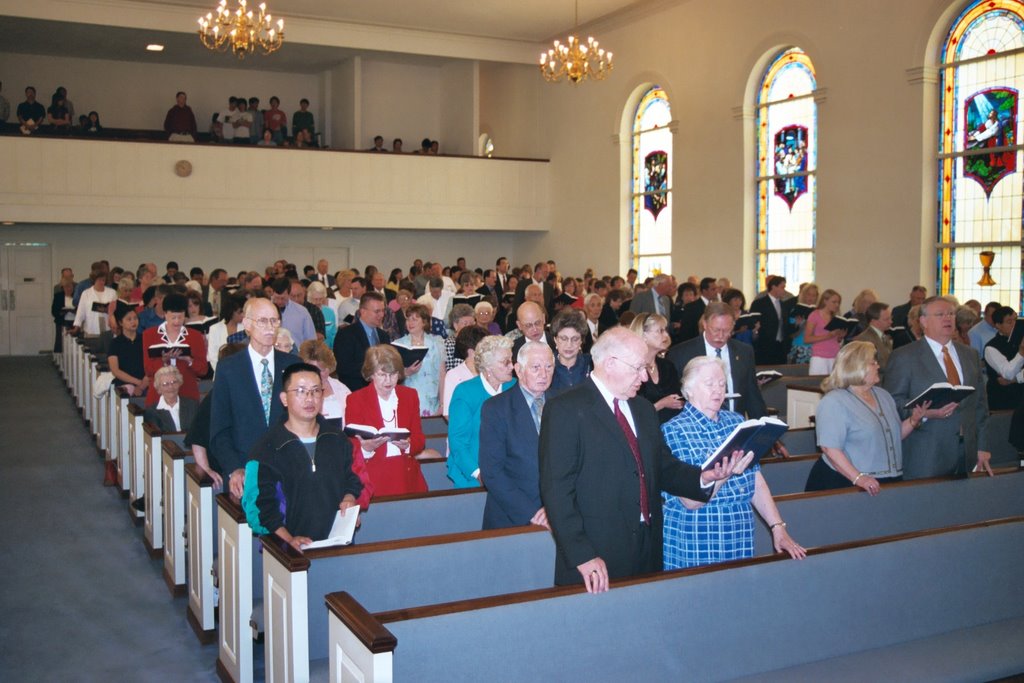
By piecing together three pictures, I can give you a pretty good panorama of the sanctuary here at Immanuel. It was great to see it so full on our Anniversary Sunday! Click the picture for a larger view.

Haggai 2:1-9 -- Days of Greater Glory

A message for the 60th Anniversary of Immanuel Baptist Church


Because of their idolatry, their disobedience and disregard for the things of the Lord, the prophet Jeremiah foretold of 70 years that Israel would be in captivity to Babylon, and 70 years that Jerusalem would be desolate. The first captives were taken to Babylon in 606 when Johoiakim surrendered to Nebuchadnezzar. 70 years later, in 536, Cyrus, ruler of the Medo-Persian empire which had swallowed up Babylon, issued a decree allowing the Jews to leave Babylon, return to their own land and rebuild their temple. Jerusalem had laid desolate from 590 until that time.

So the year is now 536, and 50,000 Jews take advantage of Cyrus’ offer for them to return. They return under the leadership of Zerubbabel, their governor. Upon returning to the land, the first thing they did was to erect an altar of God in order to sacrifice burnt offerings to Him. Two years later, 534, they began to lay the foundation for the Temple to be rebuilt.

But things got discouraging. We read in Ezra 3:12-13 that the elders began to weep when they saw how this building would pale in comparison to the former glory of Solomon’s temple. Meanwhile, the younger generation was rejoicing for they had never seen a temple before. Their whole lives had been lived in Babylon and they had only heard stories of the good old days when they worshiped at the temple. So there was much confusion. Ezra says, “the old men who had seen the first temple, wept with a loud voice when the foundation of this house was laid before their eyes, while many shouted aloud for joy; so that the people could not distinguish the sound of the shout of joy from the sound of the weeping of the people, for the people shouted with a loud shout, and the sound was heard far away.”

Then the Samaritans and other neighboring peoples began to offer to help build the temple. However if the Babylonian Captivity taught the Israelites anything, it was to keep themselves far away from idolatry. These nations were known for their idol worship and syncretistic beliefs. When Zerubbabel refused to let them help, they began to discourage and frustrate the Israelites. Then they filed a complaint to the Medo-Persian leaders, who then issued an injunction forcing the construction to cease. Feeling discouraged and defeated, the Israelites abandoned all hope of seeing a new temple.

Enter the prophet Haggai. The year is now 520 BC. The temple project has been on hold for 14 years. There is a new king named Darius who supports the repatriation plan of Cyrus, and allows the Jewish people to resume their temple building. And so Haggai brings the word of the Lord to the people of Israel. In Chapter 1, he challenged them to come out from the comfort and security of their paneled houses and resume the work of rebuilding the temple if they desired to see God move in their midst again. And the people feared the Lord and obeyed Him, and God’s presence returned in a mighty way, stirring up the spirit of the leaders and the people, and they began to rebuild the temple after 14 years of complacency.

You will notice that Chapter one ends with the date of the 24th day of the sixth month. Chapter two begins with the date of the 21st day of the seventh month. It is important to note that this is the last day of the feast of Tabernacles. The workers who have been busy rebuilding the Temple have had the week off to worship and celebrate. Just a few days earlier, they rested from working in order to observe the Day of Atonement, or Yom Kippur. They have only put about three weeks of hard work into the massive job of building the Temple. And now people have come in from all over the countryside to Jerusalem for the feast of Tabernacles. They don’t see any real progress, and what they do see doesn’t impress them.

It is in this context that God speaks to His prophet Haggai and commissions him to take this message to Zerubbabel the governor, Joshua the high priest, and all the people: “Who of you is left who saw this house in its former glory?” Here the entire remnant of the nation of Israel which has returned from Babylon is gathered together for a festive occasion and surely in that crowd were those who remembered it well. It had only been 70 years since Solomon’s Temple was destroyed. There were many who remembered the ornamentation of precious stones which adorned the temple. The entire building was overlaid with gold. Even the nails which were used in Solomon’s Temple were gold.

As their minds are filled with images of the splendor of bygone days, Haggai says, “How does it look to you now?” The people must have looked around. They might have seen rubble still to be removed from the first temple, along with just a foundation for the new, smaller temple, and maybe a few timbers for framing. “How does it look to you now?”

They were all thinking it, but no one wanted to say it. The frightening thing about the Lord is that you don’t have to say it. He knows our thoughts. And so Haggai asks rhetorically, “Does it not seem to you like nothing?” Have you ever had that lump in your throat, when you know that you have no choice but to tell the truth, but you know it is going to hurt? The answer is, “Yes, it seemed to them like nothing in comparison to the former days.”

Now I believe the Lord would have us answer a question or two here this morning as well. I believe He wants to ask us: “Who of you is left who saw this house in its former glory?” How many can remember the days when every Sunday School class was filled? Who of you is left who was here when every pew was packed every Sunday? When the budget was higher, and the building was more elaborate? God is asking us, “Who of you is left who saw this house in its former glory?”

And then He would ask of us, “How does it look to you now?” Sunday school attendance is regularly about 120. Worship attendance around 150. We won’t even mention numbers for Sunday nights and Wednesday nights. “How does it look to you now?”

And then the third rhetorical question would follow, “Does it not seem to you like nothing?” There are people in this sanctuary who have lost sleep in the last few weeks worried about what some of you might think upon returning to Immanuel today, because they are afraid you will think it seems like nothing in comparison with the former days. God knows that you have been thinking it; He is tired of us ignoring it; He brings it out into the open with these three searching questions.

Looking back is hard. There are failures in the past that some have never been able to overcome in their minds. There are successes in the past that stand as constant reminders of the glory of bygone days. But my friends, with as much love in my heart as I can possibly have, and as much respect for the traditions of this church as I can muster, I am under obligation this morning to the Spirit of God to say that He is calling for revival, and He is doing it by calling us to LOOK AHEAD! We can sit around and complain about how these days fail to compare to days before, but God says to us on this day that if we will look ahead we will see His glory in ways we have never experienced before. We might be tempted to say “Why look ahead?” And God is prepared to give us at least three reasons to look ahead to days of greater glory.

I. We must look ahead because of our Lord’s presence (v4-5)

The Israelites knew that the work ahead of them would be difficult. After quickly responding in obedience to God’s call to renew His work in the last chapter, new challenges arose. No longer was the intimidation coming from their enemies on the outside; Now there were grumblings and disputes coming from inside the camp. They were getting fed up and ready to just abandon any hope of ever seeing the glory of the Lord among them again. A young generation of people who had a heart for the Lord were about to give up because of the discouragement hurled their way by a discontent generation of those who had seen better days. In the midst of this, God sends His prophet to encourage them to stick to the work and look ahead, and He promises to give them His presence.

Do you know what the name of this church is? Immanuel: It means “God with us.” Over 100 times in the Old Testament we have the encouragement of hearing that our God is “with us.” He says in verse 4 that we can be strong and we can work, “For I am with you!” And in verse 5, He says, “My Spirit remains among you. Do not fear.”

A. His Presence Strengthens Us (v4a-c)

Three times within this one verse the call of God to His people is “Be strong!” or “Take Courage!” That command appears nearly 30 times in the Bible. Now for the Lord to command them to “Be strong!” it must mean that they were not being strong. Here, at a time when the future of the work of God depended upon them, they were weak at the task to which God had called them. I don’t know in what condition the Spirit of God may find you today, but I know this: He is calling us to revival by challenging us to look ahead; in order to do that, we must set our face against opposition and discouragement and BE STRONG! We say, “Yes, but … .” And God says, “You can do it!” We say, “But God you don’t understand.” And He says, “NO, YOU DON’T UNDERSTAND -- You can be strong because I am with you!”

We can look ahead because of His presence; and His presence strengthens us. But His presence does something else also.

B. His Presence Stirs Us (v4d)

“Be Strong,” God says, “and work. For I am with you.” God doesn’t want us just standing around being strong and doing nothing. Strength only matters when you employ it. He wants us to work. And for God to command us to work must imply that we have either ceased working or are contemplating putting an end to the work. Discouragement can cripple a person to the point where he abandons the work to which God has called him. That was the case with those who were trying to rebuild the temple in Haggai’s day. The enemy nations harassed them, but they could handle that. The work was hard, but they could handle that. The conditions were not the best, but that was no problem. But when their own people began to complain about the work that was being done, that was enough to paralyze them. “We might as well give up, because we do not have the resources to ever make this temple compare to the previous one.” Oh, don’t be so sure. Because what made that old temple special was the presence of the Lord, and He just said He was going to be with you again, so He says, “Get to work.”

C. His Presence Stabilizes Us (v5)

God commands the people to BE STRONG! He commands them to WORK! And He commands them in the latter part of verse 5, DO NOT FEAR! The people were discouraged. They were abandoning the service of the Lord. They were frightened to go on. What if God would never bless them again? What if there was no hope of revival? What if all this work is in vain? But God reminds them of something: “This is what I covenanted with you when you came out of Egypt!” In other words, “Look what I have brought you through in the past! I brought you through those things, and I have not changed! I have not departed. I can bring you through these days as well. And when I do, you will see My glory in this place again.” Oh Friends! I want you to realize something here today: God has done some amazing things here in the past -- but He isn’t finished. There is work to be done today and in the days ahead.

We say, “But look at this community, how it has changed, and how hard the people are to reach in these days.” He says, “I have not changed! Do not fear!”

And not only can we look ahead because of His presence, …

II. We must look ahead because of our Lord’s promise (v6-7)

I like what Haggai says here in verse 6: “This is what the Lord Almighty, or the Lord of Hosts, says.” In other words, if I was just standing up here talking out of my head, it would give you no reason to be encouraged. But these aren’t my words -- this is the Word of the Lord Almighty -- the One who is able to bring it about.

A. His Promise of Judgment (v6)

Beloved, we must move ahead for the cause of Christ because God Almighty Himself, not me, not Haggai, has promised that there is going to be an upheaval on the earth of His judgment. When will that happen? This is all we know -- “In a little while.” That could mean today, or might mean another thousand years or so. We do not know. But we know He has promised it. And we know His promises are true. This is the only verse in Haggai quoted in the New Testament. The writer of Hebrews refers to this in Hebrews 12:26-29 where he reminds us that the Lord is going to shake the heavens and the earth in order to institute a kingdom which is unshakable.

According to the Bible, there are only two things on this earth that are going to last forever: The souls of men and the word of God. So, since God is coming to replace the transient with the eternal, shouldn’t we be spending our time depositing the word of God into the souls of men? Jesus said, “Occupy until I come.” Don’t you want Him to find us looking ahead, anticipating His coming by engaging in that which has eternal value? Surely we don’t want Him to find us sulking over how much better things used to be!

Haggai is God’s instrument to call the people to revival. They must look ahead! They are wasting the precious minutes God has given us to do His work reminiscing about how much better the good old days were. Ecclesiastes 7:10 says, “Do not say, ‘Why were the old days better than these?’ For it is not wise to ask such questions.” If we were wise, we would be saying, “What should we do in these days, considering that the end is near?”

God’s promise of judgment ought to keep us looking ahead. But He has given us another promise as well:

B. His Promise of Jesus (v7)

Some of you might have picked up on the fact that I am using the NIV today rather than the NASB which I usually use. It is because of verse 7 that I opted for the NIV today. If you have the NASB, you might notice that this verse reads: “And I will shake all the nations; and they will come with the wealth of all nations; and I will fill this house with glory,’ says the LORD of hosts.The NIV and KJV use the phrase desire or desired of all nations.

There is much debate in contemporary scholarship concerning the meaning of this verse. Is it referring to the new temple being adorned with the wealth of the Gentiles who will come? That is what the wealth of all nations indicates. Yet that does not seem to fit with the idea of the shaking of the nations.

God has said that He is going to shake the nations. He is going to rob them of their idols and their disbelief and bring them to such desperation that they will hunger for Him. At that time, “The Desired of all nations will come.” Whether they realize it or not, their desire will be for Jesus the Messiah. He is the desire of every nation. So put this idea together: The nations are shaken, the Messiah comes, He is the one they desire, whether they know it or not. Now, where are they going to find Him? Aha! God says, “I will fill this house with glory!” In other words, there will be no question where they will find Him. They will find Him in this new temple!

About 520 years after Haggai’s day, a little baby boy is going to be presented on the steps of this new temple, Who will cause the old man Simeon to say: “Sovereign Lord, as you have promised, you now dismiss your servant in peace. For my eyes have seen your salvation, which you have prepared in the sight of all people, a light for revelation to the Gentiles and for glory to your people Israel (Luke 2:29-32).

About twelve years later, not in the old temple but in the new one, a young boy is going to be found sitting among the teachers, listening to them and asking them questions, and answering theirs, and amazing the people. It is in this new temple that he will say to Joseph and Mary, “Didn’t you know I had to be in my Father’s house?”

About twenty years after that, not in the old temple but in the new one, Messiah will come turning over tables and saying, “MY HOUSE SHALL BE CALLED A HOUSE OF PRAYER FOR ALL THE NATIONS.” It was not in the old temple, but in the new one that the veil was torn from top to bottom when Jesus’ blood was shed for the forgiveness of our sins. If you want to satisfy the desire that is in your heart when God shakes you up, Haggai says, “You will find Him in this house!”

The hardest thing facing us in ministry today is that we are surrounded by an apathetic culture which doesn’t think they need God in their lives. But God isn’t going to let them go on thinking that forever. He is going to shake them up. There will come a time when every person in this community and in this city will turn their thoughts toward God. And when they do, will they think that Immanuel Baptist Church is a place they can turn and find the answers to the questions they are asking? When God shakes the hearts and lives of those around us, where will we be? Will we be sulking about how things used to be, or will we be there pointing them to Jesus?

We must look ahead because of His presence and because of His promise. But then finally …

III. We must look ahead because of our Lord’s Provision (v8-9)

The people were discouraged! They were wondering if they could ever get this building finished and have it be remotely similar to the Temple they loved so much in days gone by. They were poor! They couldn’t afford to do all that Solomon did to adorn the temple! They were depressed, and frankly, they were beginning to get on each other’s nerves. They were at each other’s throats out there. The Lord’s work can’t get done that way! There is a need for resources, there is a need for vision, there is a need for harmony! And God says, “Say no more, because I have it all.”

A. The Work of God must no longer be hindered by a lack of resources (v8).

The remnant of Israel sounded like some modern church folk: “God wants a job done? How much is it going to cost?” The people were more concerned about ornamentation than obedience. God says, “The silver is mine and the gold is mine.” And then it is significant that He is called here what He is called elsewhere in the message of Haggai -- Lord Almighty. In other words, nothing is too difficult for Him. He doesn’t need any gold or silver. He already owns it all. Every bit in every bank, every bit that is still in every pocket, and every bit that is still hidden away in mines that have yet to be dug.

We make God sound downright pathetic the way we talk. You would think He is filing Chapter 11 or something. We don’t take an offering every week because God is poor and needs our help. We do it because it is all His to begin with. I am not giving Him what is mine. I am giving back to Him what is already His. And when I do that it shows a few things: It shows that I recognize Him as sovereign over everything I have. It shows that I desire to honor Him with every part of my life. It shows that I want to be a part of His work. You don’t want to give? Fine. Don’t give, but realize that what you are saying to God is that He does not have a right to all you have, you have no desire to honor Him with all you have, and you have no interest in His work.

But let’s remember something. If God wants something to be done for Him, money isn’t going to stand in the way. The silver and gold are His. He will provide for His work. And that tells us, if He doesn’t provide, maybe He doesn’t want it done. As we consider His provision as a reason for looking ahead, we must realize that the work of the Lord cannot be hindered by lack of resources.

B. The Work of God must no longer be hindered by a lack of vision (v9a).

We, like the people of Haggai’s day, must realize that we will never get anywhere looking back. God’s call to us is for revival, and that call is to Look Ahead! “The glory of this present house.” The people looked and they saw a pile of rubble with a small foundation and just a few timbers up for framing. They must have said, “This present house?” God says, “Yes, the glory of this present house will be greater than the glory of the former house.” It must have been a very shocking statement.

As we reminisce today about 60 years of great ministry at Immanuel, I want to tell you that the same God who was at work back then wants to do a great work right now, and He is calling His people to the task. Church, you have a great past. Praise God, but realize that God is ready for us to get serious about the future.

I believe that He is saying to us today that “this present house,” yes! God knows our attendance is lower than it used to be. He knows we don’t have the budget we used to have. He knows that our facilities lack some of the sparkle and shine that they had in former days. He knows how this community has changed. And yet, in His providence, here we are. And God is saying to us, “In this present house, my glory will be greater than in the former one.” Our theme today is “Building for Tomorrow from Yesterday’s Heritage.” This has to be our vision: Greater Glory in The Days Ahead.

C. The Work of God must no longer be hindered by a lack of fellowship (v9b).

“In this place I will grant peace.” I believe the peace God grants is holistic. I believe He is talking about peace with God and peace with man, and I don’t believe a person can have either unless he or she has both. God, the Lord Almighty, says to the people of Haggai’s day, “When my glory shows up in this place, there will be peace. There will not be any more of this competition or striving among My people.”

Now, I am going to stop preaching and start meddling for a minute. I don’t know how it happened, why it happened, or when it happened, but there has been a violation of trust and respect in the hearts of some of you. I can see it in your countenance, and I can hear it in your tone of voice. Just emotionally distance yourself for a few moments in our business meetings and listen to the tone of some of the comments that are made. And the problem is not isolated to Immanuel. It is in most churches. There is often more backbiting and gossiping in the church than there ever is in the world. There is all too often unmentioned competitiveness that stems from envy in the hearts of God’s people. This was the case in Haggai’s day. The generations opposed one another. And God’s work was hindered by it. When the people of God in His church today oppose one another, His work is hindered. And beloved this should not be!

Among His provisions for us is His peace. In order to receive it, we have to quit looking back. You say, “Pastor, so-and-so hurt me; Brother X called me a name; Sister A did something I didn’t like.” Yeah, I know. I have been hurt by some in the church worse than I ever was in the world, but I have come to realize that Jesus died for those hurts. He died for the sin that person committed when they hurt you. And He died for your sin of hard-heartedness and unforgiveness. You need ask God to help you forgive that person and move on. Let’s not just smile and pretend all is well. Let’s really do business with God and see to it that there is no broken fellowship holding us back from being what God wants us to be. We will never experience the glory of God in this place as He intends until we experience His peace. If you want revival, then you absolutely must search your heart, and apply the peace of Jesus to any broken fellowship. “In this place,” says the Lord Almighty, “I will grant peace.”

~~~~~~~~~~~~~~
Hear the Word of the Lord. He is calling us to revival, and His call is to look ahead to days of greater glory. We can do that because of His presence. God’s not worried about how many are here. We’ve got a big crowd today. Praise God. But what about next week? God says, “I am here! How many more do you need before you do something for Me?”

We can look ahead because of His promise. Judgment is coming upon this earth and Christ has called us to occupy ‘til He comes. Are we going to spend that time on futile pursuits, or are we going to invest in eternity by depositing the word of God into the souls of men? Are we going to show them the Christ that is the Desire of Nations?

We can look ahead because of His provision. He has provided all the resources we need to do His work. He has provided the vision that is necessary to guide us into the future. He has provided the peace we need to keep us in fellowship with one another.


My hero and Pastor Emeritus of Immanuel, Dr. Paul Early, and I talking before the service on April 30, 2006. Dr. Early stood strong for Christ in Greensboro in the midst of the turbulent civil rights struggle during the 1960s. Dr. Early led Immanuel to be a church for all people, making it one of the first racially integrated churches in the city. Much of the positive ministry taking place at Immanuel is today is the fruit of Dr. Early's vision. Here I am preaching the message you just read. Notice my bandaged hand from having minor surgery a few days before to remove a ganglion cyst. Several things I will mention about this photo. First, the flowers contain 10 roses for each pastor Immanuel has had. I suggested nine, and I could be represented by the thorns! Also, in the photos in this post, you can see that the IBC sanctuary is a beautiful place. The art of the stained glass windows and the "light and height" of the architecture are noticeable enhancements to the worship we offer to God in that place. Finally, notice choir members opening their Bibles. I love our choir and appreciate how they approach their ministry with a standard of excellence. I also appreciate their attentiveness to the proclamation of the word of God. Those on the front side of the pulpit see a good testimony before them when they see these choir members with their Bibles open in their laps and a pen in hand taking notes as the Word is preached.

Thank you Immanuel Baptist Church for allowing me the opportunity to minister to you! Thanks to Curry Murray, not only for the photos included here, but for his heart for the Lord and the nations that led us together as he chaired the search committee that brought me to Immanuel.

Friday, April 28, 2006

DaVinci Decoded Going Live: May 5, 2006


Yes friends, on Friday night, May 5, I will be a guest on WBFJ's Crossroad Radio, 10pm - midnight, discussing the DaVinci Code. It was supposed to air tonight, but there was a scheduling conflict. We trust God's sovereignty in the rescheduling of the event. Thanks to Deke and John for inviting me.

I invite you to tune in on radio or web and please pray for God to use me a vessel of His glory in this venture.

WBFJ can be found in Greensboro on 103.5, Winston-Salem 89.3

Listen online at www.wbfj.org (click "Listen Live" in upper right hand corner).