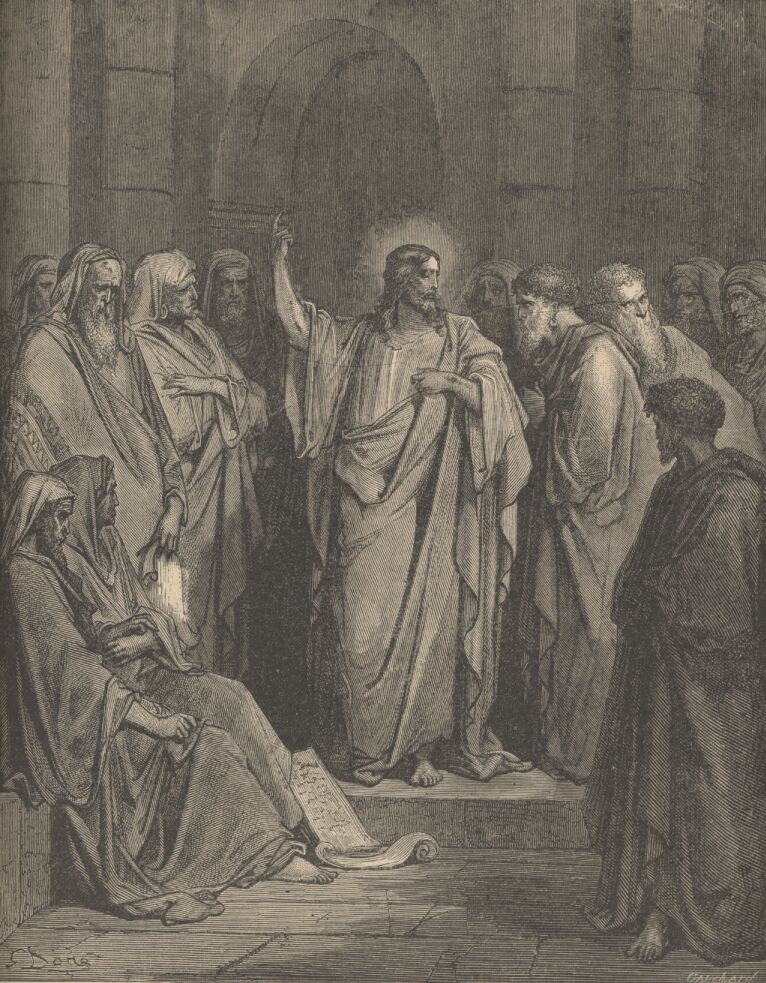
In Matthew’s Gospel, two times we read similar summary statements of the ministry of Jesus. Matthew 4:23 and Matthew 9:35 read almost identically and indicate that the regular activity of Jesus was teaching in the synagogues, proclaiming the gospel of the kingdom, and healing every kind of disease and every kind of sickness among the people. In the section of the Gospel of Mark that begins at 1:21, we see all of these activities taking place in the town of
The town of
Synagogues most likely came into existence during the Babylonian captivity when the Israelites were separated from the services of the
Luke 4 indicates that it was Jesus’ custom to be in the synagogue in whatever town He happened to be on the Sabbath day. He honored the Sabbath and the synagogue as did the apostles. This speaks to us in a day of mediocre commitment to church attendance. The synagogue offered nothing of substance to Jesus, but nonetheless, it was His custom and commitment to be there on the synagogue because that was the established time and place for the gathering of the people for the public worship of God. In our day, spirituality is at an all-time high, but church attendance is perhaps at an all-time low. I’ll just tell you, I have a hard time with someone telling me how spiritual they are if they make no commitment to gather with God’s people in a local church. In some supposedly Christian homes today, there is actually a discussion that takes place on Saturday nights or Sunday mornings about whether or not the family will attend church on Sunday. Jesus never had such discussions about whether or not to be in the synagogue on the Sabbath. He was there, and we honor His example when we prioritize the regular gathering of ourselves together in the sanctuary with God’s people on the Lord’s day. We do not attend Sabbath synagogue, but Sunday worship ought to be a priority for all who call upon the name of the Lord. It is a testimony to your children, to your extended family and to your community to hold the time and day of worship aside as sacred and let there be no debating over where you will be on Sunday mornings. Now, I will stop meddling and get back to preaching.
Jesus entered this synagogue and began teaching. Mark does not tell us what the content of His preaching was. That is typical for Mark. He speaks often of Jesus teaching and preaching, but doesn’t often tell us what was said. We know this much: His sermon in verse 15 sets the tone for all of his preaching. The time is fulfilled, and the
I. Jesus’ authority was amazing (v22a)
When the people heard Jesus teach, they were amazed at His teaching, for He was teaching them as one having authority. Mark is careful to indicate that it is not the content of His teaching that amazed them. It was the authority by which He spoke. The Greek word that Mark uses here for “amazed” (astonished, KJV) is a word that indicates that they were struck out of their normal state of mind.[1] In v27 Mark uses a different word for amazed that conveys the idea that the people were surprised, or they were caught up by the wonder of the authority of His teaching.
Now what is so amazing about authority? Aren’t we surrounded by it? All of us are under some kind of authority, and most of us exercise some level of authority. Some people have authority by virtue of a position to which they were elected. Others are appointed to authority. Some are born or married into certain levels of authority. These kinds of authority are all derived – that is, the authority is given to the individual by another. But there is a different kind of authority – inherent authority is derived from no one. It is authority that resides in the person, based on who that person is. This is the kind of authority Jesus had. It is inherent in the very nature of His person as the Son of God – God incarnate. And it amazed the people who heard Him speak.
It was not just on this occasion in the
Such was the impact of the authority of Jesus upon His hearers. When they heard Him, they were amazed. Now the reason for their amazement at His authority is indicated in the next phrase of v22, which is our next point of focus.
II. Jesus’ authority was distinct (v22b)
He was teaching them with authority, and not as the scribes. In the eyes of the common man of First Century Israel, the scribe carried more prestige than the temple priests. Priests were inaccessible, but the scribes were approachable. They could be stopped on the streets and questioned about some matter. And they were not occupied with temple rituals; they were present in the synagogue services teaching regularly. In fact, the first row of the synagogue was reserved for the scribes. They were the experts in the Torah. When there was some question about the meaning of Scripture, the scribes were able to issue binding decisions on the interpretation of a passage. They were the teachers, the rabbis. Even the name rabbi suggests how important they were. Contrary to popular opinion, the word “rabbi” is not equivalent to the word “teacher.” It literally means, “my great one.” They were the people’s professors, teachers, moral advisors, and lawyers.
The people were accustomed to hearing the teachings of the scribes. One scholar said of the scribes’ teaching that they were, “pedantic in the things that were obvious enough, and frivolous and lejune in all things that lay beyond. They would be admirable guessers and mighty in platitudes. They would ingenious in raising microscopic doubts, and perfect adepts in conjuring up conceit to do battle with conceit. They would be skillful in splitting hairs to infinity, and they would be proud of their ability to lead their hearers through the endless mazes of the imaginations of preceding rabbis, imaginations that ended in nothing or in something that was actually worse than nothing. But they would have no power, or almost none, to move the conscience toward true goodness, or to stir the love of the heart toward God and toward men.”[3]
They merely regurgitated the sayings and writings of rabbis that preceded them, moving the people farther and farther away from the actual Word of God. People came to the synagogue to hear the Torah expounded. They craved the Word of God. But what they heard was the speculations of the ancient rabbis about the Torah. Sometimes what they heard was the speculations of the rabbis on the speculations of the speculations on the speculations ad nauseum tracing somewhere hopefully back to the Torah. Rabbi Hillel was one of the most revered rabis of the first century, but it is said of him that on one occasion, he spoke on a matter all the day, but the people did not receive his teaching until he said, “Thus I heard from Shemaiah and Abtalion.”[4]
Jesus did not teach this way. When He spoke, the people heard God’s word in all of its divinely inspired authenticity and authority. He pointed to no outside authority except the Scriptures themselves and His Father in Heaven. His teaching was not speculation but certainty; not suggestion but command. And He shifted the people’s understanding of the ways of God away from the endless imaginations of the rabbis to the sole authority of “Thus saith the Lord.” And the people were amazed by His authority because it was distinctively different from their rabbis and scribes.
Now thirdly …
III. Jesus’ authority was evidenced (vv23-45)
The remainder of Mark 1 describes the events that took place over the next 24 hours. It was a busy day for Jesus, but a day in which the signs and wonders He worked affirmed in the hearts of His hearers the authority by which He spoke. He not only sounded like He had authority, He proved His authority through His actions throughout this long Sabbath day. Before He ever left the synagogue, He cast a demon out of man, causing people to say in v27, “What is this? A new teaching with authority! He commands even the unclean spirits, and they obey Him.” And as the sun set, and people felt relief from Sabbath restrictions, they began bringing to Him “all who were ill and those who were demon-possessed (v32). Mark says that the whole city had gathered at the door or Simon Peter’s house (v33). And He healed many, and cast out many demons, proving His divine authority.
Now, you and I are prone to wonder, “Why does God not prove Himself today with miracles like this?” You may be surprised to know that He didn’t always do it this way in biblical times. In fact, notice even in verse v34 that He healed many, but not necessarily all. In fact, there are only five periods of time in the Scripture when miracles occurred on a frequent basis: 1) Creation; 2) The Exodus; 3) The beginnings of the prophetic ministry of Elijah and Elisha; 4) The ministry of Jesus; and 5) The ministry of the apostles. Now, what do all these periods of time have in common? In each of them, God was affirming the proclamation of His word. Not since the first century has there been a demonstration of the miraculous on a frequent and regular basis. Why? Because God has completed His word and expects us now to believe it on His authority and not seek for signs and wonders as proof of who He is and what He can do. You can hold in your hands today something that none of the saints of the biblical centuries had: the complete written revelation of God recorded for us in the Bible. God has given this miraculous gift to us – an inerrant and infallible revelation of Himself, and if we will not receive and believe it as the Holy Spirit works within us to illuminate and convict us, then we will not believe even if we see signs and wonders. What did Jesus say about the rich man perishing in Hades in Luke 16? He pleaded that the Lord would send Lazarus back from the dead to warn his loved ones to get right with God so they would not likewise end up in hell. But that rich man was told, “They have Moses and the Prophets; let them hear them. … If they do not listen to Moses and the Prophets, they will not be persuaded even if someone rises from the dead.”
God has come into this world incarnate in the person of Jesus Christ, satisfied all the demands of His own holy and righteous standard, and died as a substitutionary sacrifice for our sins on
Jesus has commissioned us to take this gospel of His salvation into all the world and proclaim it and make disciples for Him. But He did not tell us to do it alone. You know the Great Commission as it is written in Matthew 28: Go ye therefore and make disciples of all the nations. Now what is that therefore there for? The verse immediately preceding, Jesus says, “All AUTHORITY has been given to Me in heaven and on earth. GO THEREFORE.” We go out under His divine authority and He has chosen to work through the proclamation of His divine word to bring men and women into a relationship with Himself. That Word came from Him, it was authenticated through Him, and it has been given to us to go and proclaim with His authority. What more do we need?
Now, allow me to conclude with a few points of application.
- Do you revere the word of God? When Jesus spoke the Word of God, the people were amazed at the authority of His teaching. When you read the Word of God, or hear it proclaimed, how do you respond? Do you close the book and say, “That was nice,” or do you find yourself in awe of God’s truth and allow Him to use it like a scalpel to perform the necessary spiritual surgery He desires to do in your life, bringing you to salvation first, and to a life of godliness thereafter? Through the prophet Isaiah, God declared, “To this one I will look, to him who is humble and contrite of spirit, and who trembles at My word.” Do you tremble? Are you amazed at God’s word, or is it to you just another book? A good one, a nice one, but just a book? Today perhaps God is challenging you to change the way you approach the Word of God. Really, when you open the pages of Scripture, you are approaching God Himself through His revelation of Himself. And when we encounter Him there, we ought to be amazed. We ought to tremble.
- Are we like the rabbis and scribes? Are we more concerned with the traditions of men than the power of God? We have a beautiful building, and very moving worship experiences together, and good times of fellowship, but these are all externals. Is there real life change taking place under the authority of God’s word? If not, then I suggest to you that all of our formalities and ceremonies are null and void. We are not being the church, we are just playing a church game. But if we humble ourselves to the authority of God’s word and allow Him to exercise His authority over us, to mold and shape us, to really CHANGE us and use us to change the lives of those in this community, then all that we do will take on new meaning and we will be amazed at how God will work through His authoritative word.
- Finally, when you speak, when you teach, when you witness, do you do so with authority? We do not have inherent authority in and of ourselves as Jesus did, but through His commission and the work of His Spirit within us, we have a derived authority whereby we point people, not to our own ideas or the thoughts of other men, but to the very word of God. Much of what goes on in churches today sounds like this: “I think that it is possible that what God might be suggesting is …” Where is the authority in that? Where is the certainty, the confidence? God doesn't make suggestions. He commands, and as we preach and teach and witness about Him, we must do as Richard Baxter said, “Screw the truth into people’s minds.” We do this as we speak God’s truth and stand on His authority in our preaching, our teaching, and all our conversations. Without shame or embarrassment, we can point individuals to the pages of Scripture and say with confidence and authority, “Thus saith the Lord,” and if they disagree, they don’t disagree with us but with Him, and we can leave it to Him to convict them, to convince them, and to convert them. Sunday School teachers, what is the authority of your teaching? It is not the Lifeway study guide, or the Greensboro News and Record, or Oprah or Dr. Phil, or some notion in your head. If your teaching is not derived directly from the Word of God, it has no authority, and you need not be surprised when you see very little real life change taking place. Christian, when you witness to your friends and neighbors, where is your authority? Is it in your appeal, your technique, your likeableness, or your salesmanship? If so, be no surprised when that lost person does not respond or responds only superficially. We have no authority but the Word of God, and when we share His Word under His authority, it is like letting a lion out of a cage. We merely stand back and observe God do the work He has promised to do.
[1] D.
[2] Roy B. Zuck, Teaching as Jesus Taught (Grand Rapids: Baker, 1994), 46-47.
[3] James Morrison, A Practical Commentary on the Gospel According to St. Mark (London: Hodder and Stoughton, 1892), 22. Cited in Dwight Pentecost, The Words and Works of Jesus Christ (Grand Rapids: Zondervan, 1981), 144.
[4] Cited in Zuck, 49.


No comments:
Post a Comment