Monday, October 16, 2006

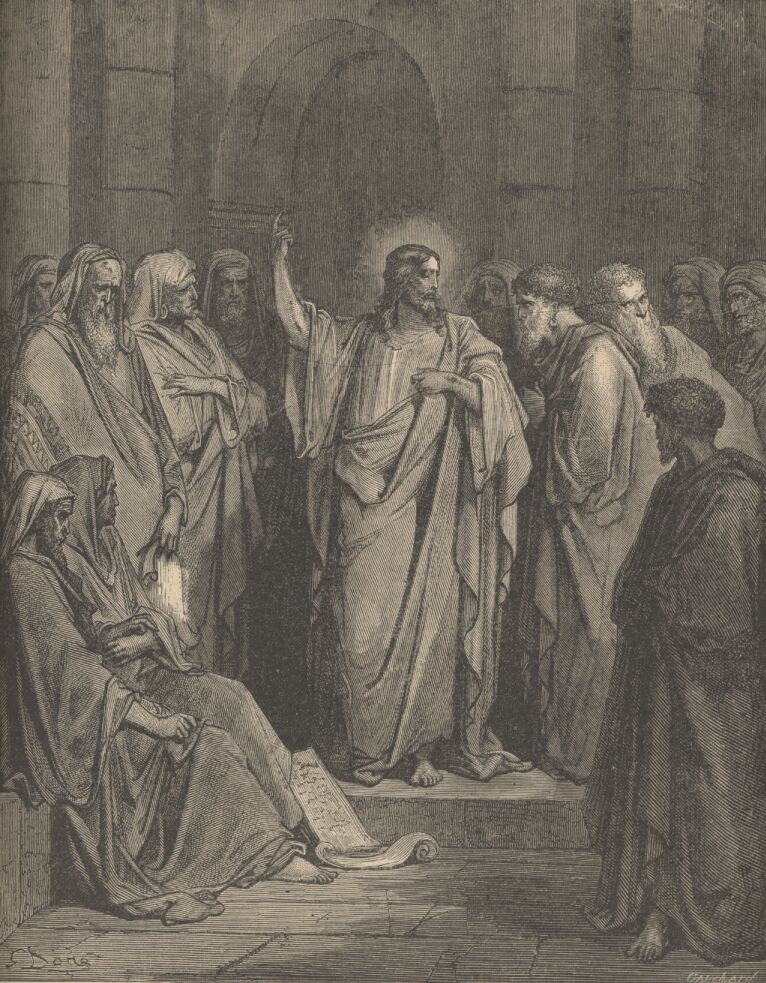
Mark 1:23-28: A Spiritual Showdown at the Synagogue

Last week, we focused on the two verses preceding this passage and the idea of Jesus’ authority that the people recognized as He taught. Then we made a passing glance at this section and those that follow as evidences of His authority. In fact, authority is a recurring theme throughout the Gospel of Mark, but one that is in sharp focus in the section from 1:21 to 2:12. We have to keep that in mind today because we do not want to lose sight of the fact that this encounter was a demonstration of the authority of Christ, given to validate the authority of His teaching.

C. S. Lewis said in the Preface to The Screwtape Letters, “There are two equal and opposite errors into which,” people fall concerning demons. One, he said, “is to disbelieve in their existence. The other is to believe, and to feel an excessive and unhealthy interest in them.” The demons themselves, Lewis says, “are equally pleased by both errors.”[1] We want to avoid both of these errors. We don’t want to ignore the reality of demons in our world, but we also don’t want to obsess about it and develop an unhealthy fascination with demons. If we will concentrate on what we can learn from the Scriptures, we will be protected from both extremes. The Bible does not tell us as much as our curiosity may desire, but the accounts we have in Scripture tell us all we need to know to understand who demons are and how they operate. In this passage before us today we see something of the nature of demons, the activity of demons, and the destiny of demons.

I. The Nature of Demons (v23)

The word demon does not occur in this passage, but instead we read that this man had an unclean spirit. The word unclean means literally “polluted” or “contaminated,” but in Jewish thought, it had come to also be understood as “ungodly.” Fourteen passages of Scripture use this terminology to describe demons. The term unclean spirit speaks to us of the nature of who these spiritual beings are. To understand them, we need to see what the Scriptures teach about their origin.

Hold your place at Mark 1, and turn over to Revelation 12, where the Apostle John records a vision which he saw concerning a war that took place in heaven. We read in Isaiah 14 and Ezekiel 28 that Satan sought to elevate himself above the very throne of God because of his pride, and this is what sparked the war. In Revelation 12:3, John says that there was a great red dragon. We are told who he is in v9: the serpent of old who is called the devil and Satan. Verse 4 says that his tail swept away a third of the stars of heaven and threw them to the earth. Stars are occasionally used, especially in Revelation, to depict the angels. If we keep this in mind, we see in v7 that Michael and his angels were waging war with the dragon and his angels. Verse 8 tells us that the dragon and his angels were evicted from heaven, and thrown down. He and his angels were thrown down to the earth, and we see that their primary occupation on earth is deceiving the whole world. When did this war happen? Well, we know from Genesis 1:31 that when God finished His creative work, which would include His creation of the angels, it was all very good. But by Genesis 3, the serpent is in the garden deceiving Eve and tempting Adam to abandon God.

Now from this, we can ascertain several important details about demons. First, they are fallen angels, who followed Satan in his rebellion against God. Second, they number one-third of the angels whom God created. We don’t know how many that is, but we know they are outnumbered 2 to 1 by the angels who maintained their rightful place as God’s servants. They have been kicked out of heaven, sentenced to roam the earth, and there they set out to deceive people.

So, as you turn back to Mark 1, let’s give a summary statement here about the nature of the demons: “Demons are evil angels who sinned against God and who now continually work evil in the world.”[2] They number one-third of the angels created by God. Like the rest of the angelic order, they do not have physical bodies, but are spirit-beings.

Now consider with me …

II. The Activity of Demons

Satan and his demons are at war with God. They cannot strike God directly, so they seek to strike that which is most precious to God – humanity. And they do so with certain tactics. Jesus said in John 10:10 that He came that we might have life and have it abundantly. He contrasts His mission with that of the enemy, whom He says comes to steal, kill, and destroy. I remember a picture floating around the internet in the days following the terrorist attacks of 9-11 showing what looked to be the image of a demonic face in the smoke of the Twin Towers. Many people were wondering if it was real or if it was a photoshop trick. But I told several people that I do not need to see Satan’s face when he has so clearly left his fingerprints. Anytime there is stealing, killing, and destruction, you know who is behind it. These are his fingerprints; we don’t need to see his face.

In this passage we are studying today we see three characteristic activities of demons.

A. Disrupting the Worship of God

Keep in mind the setting of this incident. It was the Sabbath, and it was in the synagogue. People had gathered together for the public worship of God, and in the midst of it, there was a crying out. While folks might be tempted to look at this man and say, “Can’t that crazy man just be quiet,” the fact is he cannot, for he is no longer in control of his own faculties. Instead, the demon has taken over and creates a disturbance which disrupted the worship that the people had come to offer God.

You recall that at the root of Satan’s rebellion was his desire to divert worship away from God to himself. In fact, Satan and his demons are not dead set on making devil-worshipers. They are just as content for people to worship anyone or anything other than God, who alone is worthy of worship. In my preparation for this message, I ran across a number of accounts in recent literature written by sound, conservative biblical scholars who observed this very sort of activity going on in public worship services in our day. Individuals would cry out, or act out in ways that took people’s focus off of God. Certainly we would not want to go so far as to say that any and every disruption that hinders worship is the effect of demonic activity, we would not want to dismiss the possibility. I would not want to suggest that when a baby cries or someone coughs or sneezes in a worship service, that person is possessed by demons. But, I would say that if someone is acting in a deliberate fashion to break our concentration on God and divert attention to himself or herself, or toward any other person or thing, we should rule out the possibility that Satan has planned to use that person for his purposes. When the demon inside this man cried out, it was a strategic act of the demons to disrupt the worship of God.

B. Distracting from the Proclamation of the Gospel

Also notice the timing of this incident. Verse 21 tells us that Jesus had begun to teach. We do not read that He was finished. We are not wrong to assume that it was in the midst of His teaching, as the people were caught up in amazement at His authoritative words, that the demon began to cry out. Why? Because the gospel is a threat to the forces of evil.

Satan has a grip on lost souls. He has them blinded and bound, and he knows that they will be his forever unless they are delivered by the power of God in the gospel. So, when the gospel is proclaimed, Satan and his demons work powerfully to distract individuals from understanding or responding to Christ. Paul talks in 1 Timothy 4 about doctrines of demons, and says in 1 Corinthians 10 that when people sacrifice to idols they are sacrificing to demons. Satan and his demons are behind all false religion because it keeps people distracted from the true gospel of salvation in Christ. It is a fact of history that Mohammed himself was unsure if the visions he had which led to the founding of Islam were from God or a demon. References to this can be found even in Islamic literature. And today, Islam is one of the many strongholds Satan uses to blind people to the gospel.

If you share Christ with enough people, you will eventually come to see how the enemy will use the minutest distractions to break people away from hearing the gospel. There will be interruptions of all sorts that Satan and his demons are using to convince that person that there are more important matters to tend to than the gospel. And when you encounter this, you need to be aware that you are in the midst of spiritual warfare. Satan does not mind people being curious or dabbling in religion, but when the call to salvation goes forth, it is a direct strike against his stronghold on that person’s life, and he will use all sorts of tactics to distract that person from the gospel.

... (contemporary missiological illustration removed for the safety of mission personnel and security of their work) ...

It was the same way in Capernaum, as Jesus was teaching and the people were amazed, this demon began crying out to distract not only the demonized man, but the rest of the congregation from message of the gospel.

The third activity of demons we see in this passage is …

C. Destroying Human Life

Notice that the demon had overtaken this man’s personality and identity. He could not control the outburst of the demon within him, and when Jesus rebuked the demon, the demon threw the man into convulsions. In another account in Mark 9, we read about a boy who was demonized. The demon made him dumb – that is unable to speak. And the boy’s father said, whenever it seizes him, it slams him to the ground and he foams at the mouth, and grinds his teeth and stiffens out. … It has often thrown him both into the fire and into the water to destroy him.”

In Mark 5 we read about another demonized man who lived among the tombs. And Mark says that “no one was able to bind him anymore, even with a chain; because he had often been bound with shackles and chains, and the chains had been torn apart by him and the shackles broken in pieces, and no one was strong enough to subdue him. Constantly, night and day, he was screaming among the tombs and in the mountains, and gashing himself with stones.”

All these stories indicate that the demons were seeking to destroy the individual whom they afflicted. In Psalm 106:37, we read that the demons were behind those ancient pagan religions which commanded the people to sacrifice their children to the idols. “Satanic or demonic activity always tends toward the ultimate destruction of parts of God’s creation and especially of human beings who are made in the image of God.”[3] Unable to strike God, they strike His image in man, and seek to steal, kill, and destroy it. Stealing it – by hijacking the individual to make them an unwilling slave of Satan. Killing it – by inflicting bodily harm upon the individual. Destroying it – by ultimately desiring that the individual be separated from God for eternity in hell.

Now, finally, I want us to look quickly at …

III. The Destiny of Demons

The demons are intelligent. They are aware of spiritual realities. Notice in v24 that they know exactly who Jesus is. The demon refers to Him as Jesus of Nazareth and says, “I know who You are – the Holy One of God.” And the demons know their future. “Have you come to destroy us?” They know exactly why Jesus had come. First John 3:8 says, “The Son of God appeared for this purpose, to destroy the works of the devil.” They know that the beginning of Christ’s earthly ministry means the beginning of the end for them. James says in James 2:19 that it is not enough for us to merely believe the intellectual facts about God, for he says, “the demons also believe, and shudder.” They shudder because of what they know. They know that Jesus is the Christ, the Holy One of God, and that He has come to destroy their works.

Jesus rebuked the demon with a simple word of divine authority, “Be quiet and come out of him!” And the demon did just that. Demons are not autonomous. They must submit to the authority of Jesus. And again, this caused amazement among the people (v27).

When Jesus was questioned in Matthew 12 about the authority by which He casts out demons, Jesus responded, “How can anyone enter the strong man’s house and carry off his property, unless he first binds the strong man? And then he will plunder his house.” In saying this, Jesus was saying that He had authority to enter where Satan’s dominion had gone unchallenged, and “plunder his house,” that is, liberate the captives from Satanic and demonic bondage. And His power to do this was His authority as the Son of God. He said, “If I cast out demons by the Spirit of God, then the kingdom of God has come upon you.” It was a proof of His identity and His mission to establish God’s kingdom.

We read in the book of Revelation that there is coming a day when Christ will reign on earth for 1,000 years, and during that time, Satan and his demons will be bound in a pit. But they will be loosed for a little while after that time, and they will gather the nations for the battle of Armageddon. But at that battle, by the word of Christ’s authority, Satan and all his forces will be fully and finally defeated forever. We read in Revelation 20:10 that they will thrown into the lake of fire and brimstone, … and they will be tormented day and night forever and ever. Jesus said in Matthew 25:41 that this eternal fire was prepared for the devil and his angels. But we also read that this will be the place of eternal torment for all people whose names are not written in the Lamb’s book of life – that is, those who do not know Jesus Christ as their Lord and Savior.

That is what Satan and his demons want – they know they can’t escape their destiny, so they want to take as many with them as they can. And they deceive, distract, disrupt, devour and destroy to keep people from being liberated by the gospel of the grace of God.

Today, it may very well be the case that someone in our midst is lost apart from Christ, deceived by Satan and his demons into thinking that their own goodness or some other belief is going to put them in a better place when they die. But it is a lie. Our only hope is Christ. So I want to ask you today, if you never have before, to come to Christ and call upon Him as your Lord and Savior and experience the abundant life that He came to give.

And if you are a believer in Christ today, I want to caution you – Satan is still out to devour you. He knows that you belong to Christ and he can’t have you forever, but he will be content to destroy your testimony for Christ by leading you away from your walk with God. But know this – the word of God is sure: Greater is He who is in you than he who is in the world. That is a promise from 1 John 4:4. The strongman who occupies your life now is Christ, and Satan cannot bind Him. But he will continue to attack you and seek to destroy your life and your witness. And in the midst of attack, you have this promise from James 4:7-8, “Submit to God. Resist the devil and he will flee from you. Draw near to God and He will draw near to you.” And remember that Satan took one-third of the angels when he fell. That means that for every demon, there are two angels whom God has commissioned to render service for the sake of those who will inherit salvation according to Hebrews 1:14. That is you and I if we have been born-again by faith in Christ. So, you need to be aware of demonic activity, but you need not be afraid of it. But you can come against His attacks by putting on the armor of God and taking up the sword of the Spirit which is the word of God, by living a determined life of godliness, and by claiming victory through the authority of Christ.




[1] C. S. Lewis, The Screwtape Letters, (New York: MacMillan, 1961), 3.

[2] Wayne Grudem, Systematic Theology (Grand Rapids: Zondervan, 1994), 412.

[3] Grudem, 425.

Thursday, October 12, 2006

A misplaced emphasis ...

I am spending a little time this afternoon getting caught up on cataloging books in my personal library, so I am blowing the dust off of some volumes that have been sitting in a corner since the day I bought them. As I opened a book I bought at an antique store and began to peruse it to determine how I shall classify it, I was struck by a quote I would like to share.

The book is called The Experimental Note, written by Wilbur Fletcher Sheridan, copyright 1911. While I have not read enough of the book to endorse en toto, I am intrigued enough by some lines in the early going to give it a more thorough read later. Look at this sentence from the first paragraph of the first chapter:

"A misplaced emphasis by the preacher changes God's evangel into man's evasion and is more fatal than many heresies."

Here are a few more quotes from the early chapters:

"How narrow Jesus and the apostles were! What themes they left untouched in their preaching! Their messages, like the shells of the Japanese gunners, all struck the center. The speculative preacher, on the contrary, seems to go on the supposition, as George Jackson puts it, 'that the chief end of man is to speculate on the unknown and argue about it forever.'"

"If I say that Jesus Christ died, I have declared a truth, but it is simply a history. If I say that Jesus Christ died for my sins, I have a gospel. ... A biographical Christ for the world's interest and entertainment is a very different thing from an evangelical Christ for the world's salvation. We are not always preaching the gospel when we preach about Christ. We are always preaching the gospel when we preach Christ. Take the lectures of Dr. Richard S. Storrs on 'The Divine Origin of Christianity as Shown by Its Historical Effects' as an illustration of preaching about Christ, and compare them with the sermons of Charles H. Spurgeon or Alexander Whyte as an illustration of preaching Christ. The former is a classic as a Christian apologetic. But it is not the gospel. It might be preached a thousand times and it would not save one sinner from his sins. But the sermons of Spurgeon led multitudes to Christ, both by their spoken utterance and by the printed page. ... We need a dozen or so volumes of sermons of the type of Dr. Storr's elegant classic, but we need millions of the kind that Spurgeon preached."

"Young men entering the ministry with a longing for scholarship and culture, and at the same time with a passion in their hearts to follow Jesus in His work of saving men, have had nothing so hard to bear as this attitude of sneering criticism by older men ... who stigmatize evangelism as emotional, ephemeral, superficial, and as enlisting minds only of small caliber. These wounds are hardest to bear because they are the wounds received in the house of our friends."

"[I]f you have a sure message--one that you have fallen down upon in the hours of your soul's great crises, and have found will bear you up gloriously--then you will never be satisfied with the speculative emphasis."

These are just a few brief highlights (more could be given) from the first two chapters of this book. I look forward to going farther with it someday when time permits. Perhaps I will find that it goes downhill from there, but it sure starts out on a high note.

The quotes are food for thought. Any comments?

Monday, October 09, 2006

Teaching with Authority: Mark 1:21-22


In Matthew’s Gospel, two times we read similar summary statements of the ministry of Jesus. Matthew 4:23 and Matthew 9:35 read almost identically and indicate that the regular activity of Jesus was teaching in the synagogues, proclaiming the gospel of the kingdom, and healing every kind of disease and every kind of sickness among the people. In the section of the Gospel of Mark that begins at 1:21, we see all of these activities taking place in the town of Capernaum through the ministry of Jesus. And the first of them is teaching in a synagogue.

The town of Capernaum was situated on the Sea of Galilee. It’s booming fishing industry, fertile soil, major trade route, and Roman government presence combined to make it an economically prosperous city. If you visit Capernaum today, you can visit the grandest synagogue in Palestine, but it isn’t the one Jesus visited. It only dates back to the fourth century. But archaeologists have discovered the foundations of a basalt block synagogue that dates back to the first century. It is very likely that this was the one Jesus visited, which we learn in Luke 7 was built by a Gentile centurion.

Synagogues most likely came into existence during the Babylonian captivity when the Israelites were separated from the services of the Jerusalem temple. They began to develop these local assemblies where they would gather for the purpose of reading and studying the Scriptures. Over time, regulations were put into place concerning their establishment and operation. They could only be established where there were ten male Jewish heads of household, and a ruler would be elected to oversee the synagogue. He would function as the librarian, custodian, headmaster of the school, and worship coordinator. He would not be the primary teacher, but would assign certain laypeople or invite guest rabbis to teach on a given Sabbath. We learn in Mark 5 and Luke 8 that the ruler of the Capernaum synagogue was named Jairus. On this particular Sabbath about which we read in Mark 1, Jairus had either invited or assigned the teaching responsibility to Jesus. This tells us that, early on in His ministry, Jesus was viewed favorably by many and respected in the community as a faithful follower of the Torah.

Luke 4 indicates that it was Jesus’ custom to be in the synagogue in whatever town He happened to be on the Sabbath day. He honored the Sabbath and the synagogue as did the apostles. This speaks to us in a day of mediocre commitment to church attendance. The synagogue offered nothing of substance to Jesus, but nonetheless, it was His custom and commitment to be there on the synagogue because that was the established time and place for the gathering of the people for the public worship of God. In our day, spirituality is at an all-time high, but church attendance is perhaps at an all-time low. I’ll just tell you, I have a hard time with someone telling me how spiritual they are if they make no commitment to gather with God’s people in a local church. In some supposedly Christian homes today, there is actually a discussion that takes place on Saturday nights or Sunday mornings about whether or not the family will attend church on Sunday. Jesus never had such discussions about whether or not to be in the synagogue on the Sabbath. He was there, and we honor His example when we prioritize the regular gathering of ourselves together in the sanctuary with God’s people on the Lord’s day. We do not attend Sabbath synagogue, but Sunday worship ought to be a priority for all who call upon the name of the Lord. It is a testimony to your children, to your extended family and to your community to hold the time and day of worship aside as sacred and let there be no debating over where you will be on Sunday mornings. Now, I will stop meddling and get back to preaching.

Jesus entered this synagogue and began teaching. Mark does not tell us what the content of His preaching was. That is typical for Mark. He speaks often of Jesus teaching and preaching, but doesn’t often tell us what was said. We know this much: His sermon in verse 15 sets the tone for all of his preaching. The time is fulfilled, and the kingdom of God is at hand. Repent and believe in the gospel. And if His last recorded synagogue visit gives us any hint as to His teaching on this occasion, we know He made some other bold claims as well. Luke 4 records an earlier synagogue visit in Nazareth when Jesus was invited to read the Scriptures. He read from Isaiah 61:1-2 where it is written: “The Spirit of the Lord is upon Me, Because He anointed Me to preach the gospel to the poor. He has sent Me to proclaim release to the captives, And recovery of sight to the blind, To set free those who are oppressed, To proclaim the favorable year of the Lord.” Straightforward enough, but it was what He said next that really shook the people up. Luke says that He close the book, gave it back to the attendant, and sat down and said, “Today this Scripture has been fulfilled in your hearing.” The people of His hometown began to rise up against Him and tried to throw Him over a cliff, but He slipped away and came to Capernaum where He called Peter and Andrew, James and John to follow Him. Together, they went into the Capernaum synagogue where Jesus began to teach. And based on whatever He said on that Sabbath in that synagogue, the people recognized His teaching as having a unique authority. It is this authority which was so evident in His teaching that I want to focus on today. We notice in the text three things about His authority. It was amazing, it was distinctive, and it was evidenced.

I. Jesus’ authority was amazing (v22a)

When the people heard Jesus teach, they were amazed at His teaching, for He was teaching them as one having authority. Mark is careful to indicate that it is not the content of His teaching that amazed them. It was the authority by which He spoke. The Greek word that Mark uses here for “amazed” (astonished, KJV) is a word that indicates that they were struck out of their normal state of mind.[1] In v27 Mark uses a different word for amazed that conveys the idea that the people were surprised, or they were caught up by the wonder of the authority of His teaching.

Now what is so amazing about authority? Aren’t we surrounded by it? All of us are under some kind of authority, and most of us exercise some level of authority. Some people have authority by virtue of a position to which they were elected. Others are appointed to authority. Some are born or married into certain levels of authority. These kinds of authority are all derived – that is, the authority is given to the individual by another. But there is a different kind of authority – inherent authority is derived from no one. It is authority that resides in the person, based on who that person is. This is the kind of authority Jesus had. It is inherent in the very nature of His person as the Son of God – God incarnate. And it amazed the people who heard Him speak.

It was not just on this occasion in the Capernaum synagogue that people were struck by His authority. At least ten times in the gospels, this is how people responded to the teaching of Jesus. They responded the same way at Nazareth in Luke 4, and then later again in Matthew 13 and Mark 6. In Matthew 7, it is how people reacted to the Sermon on the Mount. At the Feast of Tabernacles, Jesus taught in the temple courts (John 7), and again the people were amazed. He amazed His disciples with His encounter with the rich young ruler (Mark 10/Matthew 19). When He entered Jerusalem on His final week before the crucifixion, He taught in the temple and amazed the whole crowd (Mark 11/Luke 19). The Pharisees and Herodians were amazed to the point of silence in Matthew 22, Mark 12, and Luke 20. But even as a twelve year old child, those who heard him in the temple in that fascinating account from Luke 2 were amazed at His understanding and His answers. The word used in that account indicates that they were beside themselves in amazement.[2]

Such was the impact of the authority of Jesus upon His hearers. When they heard Him, they were amazed. Now the reason for their amazement at His authority is indicated in the next phrase of v22, which is our next point of focus.

II. Jesus’ authority was distinct (v22b)

He was teaching them with authority, and not as the scribes. In the eyes of the common man of First Century Israel, the scribe carried more prestige than the temple priests. Priests were inaccessible, but the scribes were approachable. They could be stopped on the streets and questioned about some matter. And they were not occupied with temple rituals; they were present in the synagogue services teaching regularly. In fact, the first row of the synagogue was reserved for the scribes. They were the experts in the Torah. When there was some question about the meaning of Scripture, the scribes were able to issue binding decisions on the interpretation of a passage. They were the teachers, the rabbis. Even the name rabbi suggests how important they were. Contrary to popular opinion, the word “rabbi” is not equivalent to the word “teacher.” It literally means, “my great one.” They were the people’s professors, teachers, moral advisors, and lawyers.

The people were accustomed to hearing the teachings of the scribes. One scholar said of the scribes’ teaching that they were, “pedantic in the things that were obvious enough, and frivolous and lejune in all things that lay beyond. They would be admirable guessers and mighty in platitudes. They would ingenious in raising microscopic doubts, and perfect adepts in conjuring up conceit to do battle with conceit. They would be skillful in splitting hairs to infinity, and they would be proud of their ability to lead their hearers through the endless mazes of the imaginations of preceding rabbis, imaginations that ended in nothing or in something that was actually worse than nothing. But they would have no power, or almost none, to move the conscience toward true goodness, or to stir the love of the heart toward God and toward men.”[3]

They merely regurgitated the sayings and writings of rabbis that preceded them, moving the people farther and farther away from the actual Word of God. People came to the synagogue to hear the Torah expounded. They craved the Word of God. But what they heard was the speculations of the ancient rabbis about the Torah. Sometimes what they heard was the speculations of the rabbis on the speculations of the speculations on the speculations ad nauseum tracing somewhere hopefully back to the Torah. Rabbi Hillel was one of the most revered rabis of the first century, but it is said of him that on one occasion, he spoke on a matter all the day, but the people did not receive his teaching until he said, “Thus I heard from Shemaiah and Abtalion.”[4]

Jesus did not teach this way. When He spoke, the people heard God’s word in all of its divinely inspired authenticity and authority. He pointed to no outside authority except the Scriptures themselves and His Father in Heaven. His teaching was not speculation but certainty; not suggestion but command. And He shifted the people’s understanding of the ways of God away from the endless imaginations of the rabbis to the sole authority of “Thus saith the Lord.” And the people were amazed by His authority because it was distinctively different from their rabbis and scribes.

Now thirdly …

III. Jesus’ authority was evidenced (vv23-45)

The remainder of Mark 1 describes the events that took place over the next 24 hours. It was a busy day for Jesus, but a day in which the signs and wonders He worked affirmed in the hearts of His hearers the authority by which He spoke. He not only sounded like He had authority, He proved His authority through His actions throughout this long Sabbath day. Before He ever left the synagogue, He cast a demon out of man, causing people to say in v27, “What is this? A new teaching with authority! He commands even the unclean spirits, and they obey Him.” And as the sun set, and people felt relief from Sabbath restrictions, they began bringing to Him “all who were ill and those who were demon-possessed (v32). Mark says that the whole city had gathered at the door or Simon Peter’s house (v33). And He healed many, and cast out many demons, proving His divine authority.

Now, you and I are prone to wonder, “Why does God not prove Himself today with miracles like this?” You may be surprised to know that He didn’t always do it this way in biblical times. In fact, notice even in verse v34 that He healed many, but not necessarily all. In fact, there are only five periods of time in the Scripture when miracles occurred on a frequent basis: 1) Creation; 2) The Exodus; 3) The beginnings of the prophetic ministry of Elijah and Elisha; 4) The ministry of Jesus; and 5) The ministry of the apostles. Now, what do all these periods of time have in common? In each of them, God was affirming the proclamation of His word. Not since the first century has there been a demonstration of the miraculous on a frequent and regular basis. Why? Because God has completed His word and expects us now to believe it on His authority and not seek for signs and wonders as proof of who He is and what He can do. You can hold in your hands today something that none of the saints of the biblical centuries had: the complete written revelation of God recorded for us in the Bible. God has given this miraculous gift to us – an inerrant and infallible revelation of Himself, and if we will not receive and believe it as the Holy Spirit works within us to illuminate and convict us, then we will not believe even if we see signs and wonders. What did Jesus say about the rich man perishing in Hades in Luke 16? He pleaded that the Lord would send Lazarus back from the dead to warn his loved ones to get right with God so they would not likewise end up in hell. But that rich man was told, “They have Moses and the Prophets; let them hear them. … If they do not listen to Moses and the Prophets, they will not be persuaded even if someone rises from the dead.”

God has come into this world incarnate in the person of Jesus Christ, satisfied all the demands of His own holy and righteous standard, and died as a substitutionary sacrifice for our sins on Calvary’s cross, and risen from the dead. He has sent His Spirit to move upon His apostles to complete His infallible and inerrant Word as a revelation of Himself to us. What more does He need to do? I am not about to say that God no longer does the miraculous. He can, and He does whenever He wills. But we must understand that His word has received the ultimate validation in the resurrection of Christ from the dead, and for us to insist on Him doing more in our day is to cheapen the cross of Christ and His resurrection and to devalue the Word of God of its authority and power.

Jesus has commissioned us to take this gospel of His salvation into all the world and proclaim it and make disciples for Him. But He did not tell us to do it alone. You know the Great Commission as it is written in Matthew 28: Go ye therefore and make disciples of all the nations. Now what is that therefore there for? The verse immediately preceding, Jesus says, “All AUTHORITY has been given to Me in heaven and on earth. GO THEREFORE.” We go out under His divine authority and He has chosen to work through the proclamation of His divine word to bring men and women into a relationship with Himself. That Word came from Him, it was authenticated through Him, and it has been given to us to go and proclaim with His authority. What more do we need?

Now, allow me to conclude with a few points of application.

  1. Do you revere the word of God? When Jesus spoke the Word of God, the people were amazed at the authority of His teaching. When you read the Word of God, or hear it proclaimed, how do you respond? Do you close the book and say, “That was nice,” or do you find yourself in awe of God’s truth and allow Him to use it like a scalpel to perform the necessary spiritual surgery He desires to do in your life, bringing you to salvation first, and to a life of godliness thereafter? Through the prophet Isaiah, God declared, “To this one I will look, to him who is humble and contrite of spirit, and who trembles at My word.” Do you tremble? Are you amazed at God’s word, or is it to you just another book? A good one, a nice one, but just a book? Today perhaps God is challenging you to change the way you approach the Word of God. Really, when you open the pages of Scripture, you are approaching God Himself through His revelation of Himself. And when we encounter Him there, we ought to be amazed. We ought to tremble.
  2. Are we like the rabbis and scribes? Are we more concerned with the traditions of men than the power of God? We have a beautiful building, and very moving worship experiences together, and good times of fellowship, but these are all externals. Is there real life change taking place under the authority of God’s word? If not, then I suggest to you that all of our formalities and ceremonies are null and void. We are not being the church, we are just playing a church game. But if we humble ourselves to the authority of God’s word and allow Him to exercise His authority over us, to mold and shape us, to really CHANGE us and use us to change the lives of those in this community, then all that we do will take on new meaning and we will be amazed at how God will work through His authoritative word.
  3. Finally, when you speak, when you teach, when you witness, do you do so with authority? We do not have inherent authority in and of ourselves as Jesus did, but through His commission and the work of His Spirit within us, we have a derived authority whereby we point people, not to our own ideas or the thoughts of other men, but to the very word of God. Much of what goes on in churches today sounds like this: “I think that it is possible that what God might be suggesting is …” Where is the authority in that? Where is the certainty, the confidence? God doesn't make suggestions. He commands, and as we preach and teach and witness about Him, we must do as Richard Baxter said, “Screw the truth into people’s minds.” We do this as we speak God’s truth and stand on His authority in our preaching, our teaching, and all our conversations. Without shame or embarrassment, we can point individuals to the pages of Scripture and say with confidence and authority, “Thus saith the Lord,” and if they disagree, they don’t disagree with us but with Him, and we can leave it to Him to convict them, to convince them, and to convert them. Sunday School teachers, what is the authority of your teaching? It is not the Lifeway study guide, or the Greensboro News and Record, or Oprah or Dr. Phil, or some notion in your head. If your teaching is not derived directly from the Word of God, it has no authority, and you need not be surprised when you see very little real life change taking place. Christian, when you witness to your friends and neighbors, where is your authority? Is it in your appeal, your technique, your likeableness, or your salesmanship? If so, be no surprised when that lost person does not respond or responds only superficially. We have no authority but the Word of God, and when we share His Word under His authority, it is like letting a lion out of a cage. We merely stand back and observe God do the work He has promised to do.


[1] D. Edmond Hiebert, The Gospel of Mark: An Expositional Commentary (Greenville, SC: Bob Jones University Press, 1994), 49.

[2] Roy B. Zuck, Teaching as Jesus Taught (Grand Rapids: Baker, 1994), 46-47.

[3] James Morrison, A Practical Commentary on the Gospel According to St. Mark (London: Hodder and Stoughton, 1892), 22. Cited in Dwight Pentecost, The Words and Works of Jesus Christ (Grand Rapids: Zondervan, 1981), 144.

[4] Cited in Zuck, 49.

Wednesday, October 04, 2006

October 4

"A young man meets a girl. The whole world looks different when he sees her. Her voice reminds im of something he has been trying to remember all his life, and ten minutes casual chat with her is more precious than all the favours that all the other women in the world could grant. He is, as they say, 'in love'." C. S. Lewis, "Meditation in a Toolshed," 1945.


Today marks the ninth anniversary of our marriage, and I want to say how much I am thankful for my wife and our family. It is my opinion, admittedly biased but proudly defended, that I am married to the greatest woman on earth. Donia is a constant source of encouragement and help to me. While daily, I am called upon to minister to many, she has viewed her calling as one of ministry to me and our children. In that way, I will say that she is the model of a pastor's wife. Some people believe that a great pastor's wife should play the organ, direct the WMU, lead many ministries in the church and be involved in a host of community activities. Donia has never felt that her calling was to do any of these things, and I have never asked her to. Rather, from day one, she has prioritized the home as the realm of her ministry, giving selflessly of herself to me and the children. She would get more pats on the back from many more people doing all sorts of other things, but she has exchanged the applause of the many for the appreciation of a few and the pleasure of God as she works around the clock (sometimes literally) to make our home a haven of rest and comfort, to educate our children in homeschool, and to aid me in being the best man I can be for Jesus. Much of what God has done in and through me has been done because God has used her so wonderfully in my life. Our relationship has, from day one, been one of mutual spiritual edification -- and though she may say otherwise -- it has mostly been her edifying and strengthening me. So, though my readership is small in number, I want to say to all who come across this page today that I thank God for Donia and for the person He has crafted her to be, and I thank her for nine wonderful years of marriage, and for two beautiful children, and for all that she does day in and day out to bless our family. I love her more than I could ever tell her, and rejoice in the Lord that He has allowed us to share life together.

Below is a picture of my son and I taken at the Hurricanes' "Caniac Carnival" last Saturday. We had a terrific "Guys Weekend" in Raleigh. We went to the Canes' preseason game (which they lost) on Friday night, and Saturday we got up early and went to the Carnival. We got some autographs, watched practice, and stood in line for a long time to get this picture. Hockey players work their entire lives for an opportunity to lift this cup as the prize of their careers. Pastors work every day for the crown we will receive from the Lord (1 Peter 5:4). But God has given me a great treasure in that every day, I get to come home to a wonderful wife and two precious children. They are my pride and joy, trophies of God's grace in my life, and human agents of His daily blessings!


Tuesday, October 03, 2006

Christ’s Call to Follow: Mark 1:16-20


Southeastern Baptist Theological Seminary is like most other seminaries in many regards. Of course, it is the greatest seminary in the world as you know, but we will put that qualitative distinction aside for now. One thing that I assume is the same at every seminary is that there is an office where students and alumni put their résumés on file for churches to request when they are looking for a new pastor. Those of you who have served on search committees know how this works – you call the seminary, tell them what you are looking for, and they send you 312 résumés to filter through to find “God’s called and anointed leader.” A disclaimer: that is NOT how I became pastor of Immanuel Baptist Church. And it is not how Jesus sought out those whom He would use to turn the world upside down. He found them one day when He was out walking by a lake.

This is not what we might imagine, but then again, Mark is piling up paradoxes to indicate that this Jesus is not coming in the manner that many expected of the Messiah. In verse 7, John the Baptist declared that the Messiah was the Mightier One who was coming after him. In verse 9, however, we meet Him as Jesus of Nazareth (of all places) coming to be baptized by John. In verses 10 and 11, He is anointed with the Spirit of God and declared from heaven to be the Son of God. But in verses 12 and 13, we find Him out in the wilderness doing battle against Satan’s temptations. In verses 14 and 15, He declares that the time is fulfilled and the Kingdom of God is at hand. We might imagine that His next stop would be Jerusalem, where He would overthrow the government and establish His kingdom. However, in actuality, we find Him walking by a lake.

This was not the place to go looking for theologians. But Jesus wasn’t looking for theologians. He was looking for followers, and on the banks of the Sea of Galilee, He called four fishermen who would become the central core of His early church. There is Simon, whom Jesus will later call Peter. Morgan describes him as impulsive and wayward, lacking the principle which masters passion and makes it strong.[1] And then there is Andrew, his brother. And two other brothers, James and John – one of whom will go on to write five of the 27 NT books, and the other of whom we will come to know relatively little. Just regular guys – ordinary fishermen – who heard and responded to the call of Christ.

Having issued a call to salvation in vv14-15, Jesus now issues a call to service with two simple words: Follow Me. And I suggest to you that this is Christ’s call for us as well, so as we look at this passage, we will note the condition of His call, the consequence of His call, and the cost of His call.

I. The condition of His call (v17)

Follow Me. Just two simple words, that’s all. We know that this was not the first encounter that these men had with Jesus. John’s Gospel tells us that Andrew had been a disciple of John the Baptist and heard him point out Jesus as “The Lamb of God who takes away the sin of the world.” And Andrew began to follow Jesus then and there. Andrew went hurriedly to find his brother Peter and told him, “We have found the Messiah!” And he brought Peter to Jesus. Perhaps James and John had encountered Jesus before this seascape Mark paints for us also. Perhaps Andrew had told them of the Messiah also. But this we know – before Christ calls us to service, we must respond to His call to salvation: Repent and believe in the Gospel (v15). And once we say “yes” to that call, the next words of Christ to us are “Follow Me!”

Notice if you will that Jesus takes the initiative. Rabbis in those days did not go out seeking disciples. If a young man wanted to devote himself to rabbinic studies, he would seek out the rabbi under whom he wanted to learn and appeal to him for instruction. They may have to demonstrate a prior knowledge of the Scriptures or take an examination in Old Testament theology to demonstrate their readiness, and if accepted, the rabbi would lead the young man to be a follower of the Torah. But Jesus turned this on its head. He didn’t teach Torah. He IS the Torah – the Word made flesh that John speaks of – and He sought out individuals to follow Him. His only criteria was a willingness to trust and obey.

We might expect the Messiah to recruit His followers around the Temple or near the synagogue. But Jesus went to the lake – the workaday world of boats and nets, of blood and sweat. And the men he called were fishing. They weren’t just out for a guys weekend on the lake. They were fishermen. He called them while they were busy with their work. Kenneth Wuest says, “When God looks for someone to use in a special mission, He looks for the person who is already busy, the energetic individual.”[2] God is not interested in using the idle hands of lethargic people to do His work. He is not looking for those who don’t have anything better to do, but those who prove themselves faithful to work in whatever role they are in.

I was working at a sporting goods store when I sensed God’s call to ministry. I told my pastor I was going to quit my job and wait for God to show me what to do next. He gave me the best advice I think I ever got. He said, “No, you work hard like you are going to be the next president of that company, and you make that your ministry, and when God is ready for you to do something else, He will let you know.” I did just that and within a month I was manager, and within two more months, I had the top store in the company. And about six months later, God assured me that the time was right for me to pursue the calling to preach. And when I left, the owner of the company called and offered me any position in the company if I would stay on – my pick of stores to manage, district manager, home office (in Virginia Beach no less). But I knew God was calling me to preach, so I followed Him. But I believe to this day that I had become idle while waiting for God to confirm His call, I would still be idle today.

I have had the privilege over the last eleven years to give that same advice to a number of people who want to serve the Lord – get busy serving Him where you are, doing whatever you do for the glory of God, and God will let you know when He wants to put you in another role. I knew a lady in one church who wanted to serve God in the church, but she turned down every opportunity anyone ever offered her. She said she wanted to do something big and important. Understand that God is looking for those who are faithful in the small things before He opens the door to bigger things. You want to be effective for Christ in this church? Take that Sunday School class nobody wants to teach, get on that committee nobody wants to be on, pick up that trash in the parking lot that everybody else walks past, and do it for the glory of God and He will begin to open other doors for you in His time. He is calling us to Follow Him and if we trust and obey Him to follow Him into the work that everyone else deems insignificant, He will in His time open up more opportunities for you. But don’t be idle and call it waiting for the Lord. He is not looking for idleness, but willingness. He found these fishermen casting and mending their nets and said, “Follow me.” That is the condition of His call. If you want to serve Him, you must follow Him. And if you follow Him, He will lead you into avenues of service. That brings me to the second point.

II. The Consequence of His Call (v17)

I will make you fishers of men. Mark uses technical vocabulary for the kinds of fishing that these four were doing. Simon and Andrew were using a circular casting net that could be cast by an individual into a school of fish for a small catch. James and John were using a heavy drag net was pulled behind a boat for a large catch. And Jesus says, “I want you to take what you are doing, and use it for Me and for the Kingdom I am building.”

Fishing metaphors are common in the Bible, but usually in another context. In Jeremiah 16:16, God says He is going to send fishermen to gather people for judgment. Similar passages occur in Amos, Habakkuk, and Ezekiel. Indeed, it is no blessing for a fish to be entrapped in a net or hooked in the jaw and dragged out of the water. But the kind of fishing for men that Jesus is talking about is a part of His good news. How is it good news to be caught by the net or the hook of the gospel? Well, the fact is that all of humanity is swimming along with the current of sin, and the tributary in which we swim will empty eventually into a lake of fire. But Christ in His mercy has commissioned fishers of men, not to destroy them but to rescue them from destruction. He is drawing the net and setting the hook of the Gospel to deliver us from judgment and bring us salvation. Jesus said that no one comes to Him unless the Father draws him, and though we may not think to highly of the idea that God draws us, even drags us in some cases, once we find ourselves swimming in the fresh and clean ocean of His grace, we can’t help but give thanks and praise to Him. Thank God for those fishers of men He sent into my life. Thank God for the net that dragged me into His kingdom and the hook that pulled me from the lake of fire. And thank God that He is still calling us to fish for men to pull them from the sea of judgment.

Now I have to confess to you, the metaphor of the fisherman didn’t appeal to me at first. I have never liked fishing. Don’t get me wrong – I like catching, but you have to do a lot of fishing before you do any catching. This is not a metaphor that would appeal to everyone. He used it with fishermen because they would understand it. To those who knew farming better than fishing, he said, “The fields are white to harvest,” (John 4:35) and “Put in your sickle and reap” (Rev 14:15). The principle behind His calling is that calls us to entrust ourselves and our abilities and endeavors to Him, and whatever it is that we do, we can do for Him in the Kingdom if we will follow Him. In fact, He will make it happen.

Notice that the consequence of His call is stated as a promise. Follow me and I will make you become fishers of men. This is a promise, not of what we will do for Him, but what He will do in and through us. It is a process – I will make you become. And it a work only He can do. But His promise is that if we follow, He will make us to become fishers of men for Him. So, you want a little litmus test for your following? Look at your fishing. If you are not fishing, then you are not following. If you aren’t walking closely with Him, then you are not serving Him; and if you are not serving Him, then you aren’t walking closely with Him. Following leads to fishing. That is His promise. It is the consequence of His call, and if we trust and obey Him, we can expect Him to bring it to pass. If it doesn’t, it is a commentary on us rather than Him. His word is true and trustworthy, and to everyone whom He calls unto salvation, He also issues a call to service, and He promises to bring it about.

Now finally consider with me …

III. The Cost of His Call (vv18, 20)

There is only one appropriate response to the call of Christ – prompt and complete. That is what these men did and it is what we must do as well. But it isn’t always easy – it is almost always costly. In verses 18 and 20, we notice the repetition of the words, “they left.” What did they leave? They left their nets (v18); they left their father; they left their boat; they left their hired servants (v20). Why? Because following Him takes precedence over everything else in life. And the price these men paid to follow Christ is the same price that we may have to pay as well as we follow Him.

A. Following Christ may cost our possessions (nets, boat)

These men walked away from their nets and their boat. You have to understand that these possessions would have represented a significant financial investment on their part. They didn’t come cheap. But the glory of these possessions is no rival for the glory of Christ, and they left them behind to follow Him. Is it necessary to walk away from all earthly possessions to follow Christ? Not necessarily, but when our devotion to those things becomes a threat to our devotion to Christ, they must go. Otherwise they become an idol, they become our lord, and they begin to take ownership of us. And if that is the case, or if there is even a hint that it may become the case, we must walk away in order to follow Him.

B. Following Christ may cost our occupation (they were fishermen v16)

They didn’t just leave the tools of their trade, they left their trade. It may be the case that following Christ will require us to walk away from a career. This won’t always be the case, for the Lord can use us in many capacities in secular employment. In most cases, I think that laypeople who are faithful to God and hard workers in their secular careers are more effective witnesses for Christ than any pastor or evangelist could ever be. Paul didn’t stop making tents – he used his tentmaking to support his ministry. But in some cases, God calls us to walk away and follow Him, and our following becomes our occupation. One of my heroes is Ray Mushinski. You probably don’t know him. He was a very successful accountant with Miller Brewing Company, but as he followed Christ, he came to the conviction that he could not continue to grow rich off of the sale of alcohol. So he walked away, not to be a preacher or a missionary, but to open a Christian bookstore in Hanes Mall. I got to know Ray while I was managing the sporting goods store around the corner from him, and later I worked for him. And I respect him immensely. Following Christ cost him his occupation. He will probably never make the money selling books that he did keeping books at Miller, but if you ask him, he will tell you that following Christ is worth it. I could tell you about countless others who left high-paying jobs to enter the ministry full-time. I could tell you about others who walked away from lucrative careers, not to enter full-time ministry, but in order to find another career where they could serve Christ more effectively. We are called to follow Him, and as we do, He may lead us away from our occupation.

C. Following Christ may cost us our relationships (father)

There is no worldview which values the importance of the family more than Christianity. But even within the parameters of Christian love and honor for the family, there is a recognition that sometimes our family and friends are standing in the way of our service to Christ. In that case, we sometimes have to walk away like James and John did. We don’t know that they turned their backs on their father forever. We know they maintained close ties with their mother, because she shows up in the gospels later. My family thought I was crazy for entering the ministry, but I did it anyway, and today I enjoy a better relationship with them than ever. But for some it is not this way. Ask any Christian who converted from Islam. They will likely tell you that they were cut off from their family and friends for following Christ. But they followed Him anyway, knowing that He takes precedence over all else in life.

Hear me very carefully here: Following Christ may mean walking away from mother, father, sister, brother, or any other earthly tie – except one. Let no one, I repeat no one, ever say that they are divorcing their spouse for the glory of God. You are no longer two, but one flesh with that person, and the Bible says that even if your spouse is an unbeliever, you are to remain in the relationship as a witness to the grace of God in your life. The cost of following Christ in such cases is the cost of enduring a troubled relationship and doing all within your power to demonstrate the love of Christ to that individual. But God says in no uncertain terms in Malachi 2:16 that He hates divorce, and following Him will never lead you to do something He hates.

D. Following Christ may cost us our comfort zone (they went away, v20)

How far away did Peter, Andrew, James, and John have to go? In 2000 I preached in the harbor of Sevastopol, Ukraine, and I was told by some Christians there that Andrew had preached in that same port in the first century. That was a long way from the Sea of Galilee. They didn’t know where the road would lead them, but they weren’t following the road – they were following the Lord and they were willing to go wherever He took them. I know some who say, “God I will serve you anyway I can, as long as I can do it in Greensboro,” or “as long as I don’t have to do it in Africa.” We cannot put boundaries on the call of God. I got a call one November evening in 1997 from Emory Holbrook in Conowingo, Maryland. Never heard of it. Couldn’t find it on a map. But if I was going to follow Christ, I was going to have to go where He led me. And everybody I knew said, “There’s plenty of churches around here that need pastors,” and I had my résumé in every one of them. But God didn’t see fit to leave me here, and four months after we were married, Donia and I moved 450 miles away and spent the next five years there – which we would not trade for anything in the world.

E. Following Christ may cost us our lives.

James became the first martyr of the church; he was put to death by the sword of Herod Agrippa in Acts 12. Peter was crucified upside down in Rome. Andrew was martyred on an X-shaped cross in Achaia. John died at an old age, but suffered much, being imprisoned at least once on the desolate isle of Patmos. Dietrich Bonhoeffer said, “When calls a man, He bids him come and die.”[3] And for an untold multitude around the world and throughout the centuries, this is exactly what the call to follow has cost. I wonder, is this a price we are willing to pay for Jesus? If not, then how on earth can we say we are following Him who died for us?

Understand, there’s nothing wrong with nets, and boats, and families, and comfort zones, and life itself. But when these things become encumbrances to us, preventing us from following Christ promptly and completely, we have to loosen our grip on them and let them slip from our fingers for the sake of following Christ. It is to Him and Him alone that we must cling steadfastly, choosing rather to lose everything else in the world for Him if necessary.

You ought to hear the testimonies. Every now and then, I attend our International Mission Board’s Missionary Appointment Service. And you ought to hear what these precious men and women have given up to follow Christ to the ends of the earth. You ought to hear the testimonies of the students at three theological schools I have attended, and the one where I teach now. You say, “Oh, I am too young, too old, too rich, too poor, too ___________ (you fill in the blank),” and I will introduce you to someone who will give the lie to your excuse. Every mission trip I have ever been on, I’ve been with 60, 70, sometimes 80 year old saints who are following Christ. In every school I have attended, there have been folks who have given up the fight after too many years of resistance, and now in their 50s, 60s, even 70s, who are preparing to spend the rest of their years in active ministry. He can use you – but you must follow Him, and allow Him to make you become a fisher of men.

Today some of you need to say yes to Him. He is calling you to follow Him and let Him make you His servant. For many of you that means that in your present state, with your present job, abilities, experiences, you commit to use your daily existence to bring Him glory and fish for men. But there may be someone that God is calling to leave it all behind – possessions, a relationship, an occupation, a comfort zone. And the only acceptable response is to promptly and completely trust Him and obey.

Others of you need to heed His call to salvation – to repent and believe in the gospel. Others need to make this your church home. But however it is that God is leading you today, as we sing our invitation hymn, we invite you to come and let us pray with you and encourage you as you say yes to the call of Jesus today.


[1] G. Campbell Morgan, The Gospel According to Mark (Grand Rapids: Revell, 1927), 34.

[2] D. Edmond Hiebert, The Gospel of Mark: An Expositional Commentary (Greenville, SC: Bob Jones University Press, 1994), 45-46.

[3] Dietrich Bonhoeffer, The Cost of Discipleship (New York: Macmillan, 1967), 99.